
What's Your Nature?
Become a Nature Up North explorer to share your encounters with wild things and wild places in New York's North Country. Post your wildlife sightings, landscape shots, photos from your outings, and even your organization's events!
2019 Summer Teacher Workshop
2019 Summer Teacher Workshop for K-12 educators to show them all of the resources available through Nature Up North and introduce them to our citizen science projects.
Lesson Plan: Intro to Citizen Science
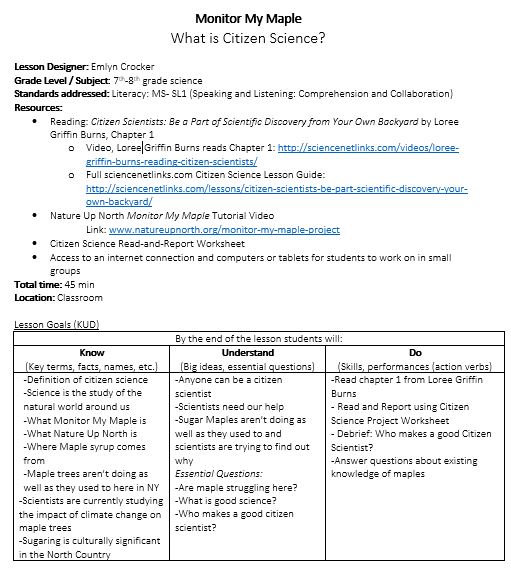
This lesson serves as an introduction to Citizen Science, including a short reading and some activities and discussion points. The lesson uses Monitor My Maple as an example, but could easily be adapted for other citizen science projects.
- Reading: Citizen Scientists: Be a Part of Scientific Discovery from Your Own Backyard (Chapter One) by Loree Griffin Burns
- Full sciencenetlinks.com Citizen Science Lesson Guide: http://sciencenetlinks.com/lessons/citizen-scientists-be-part-scientific-discovery-your-own-backyard/
- Nature Up North Monitor My Maple Tutorial Video (www.natureupnorth.org/monitor-my-maple-project)
- Citizen Science Read-and-Report Worksheet
Game cameras in STEM presentation (North Country Wild citizen science project)
This is the presentation about the North Country Wild Game Camera project
STEM with Nature Up North presentation
This is the powerpoint we gave on doing STEM with Nature Up North and our citizen science projects.
In the schools Update
This is the third presentation from the workshop updating participants on how Nature Up North works with K-12 educators.
Citizen science presentation
This is the second powerpoint presentation from the workshop: What is citizen science?
What is Nature Up North?
This is the first presentation we gave at the workshop and it provides an overview of the Nature Up North project. Note that there was a video in the original presentation that has been replaced with a link to the video so as to reduce file size.
Twins in the neighborhood
Two twins still in spots traversing the neighborhood
Breeding Birds at Heritage Island in Canton
A quick swing around the trail at Heritage Island in late July showed several species of bird breeding, including Yellow Warbler, American Redstart, and Gray Catbird. The most amusing thing to see however was the Cedar Waxwings bathing in the Grasse River.