
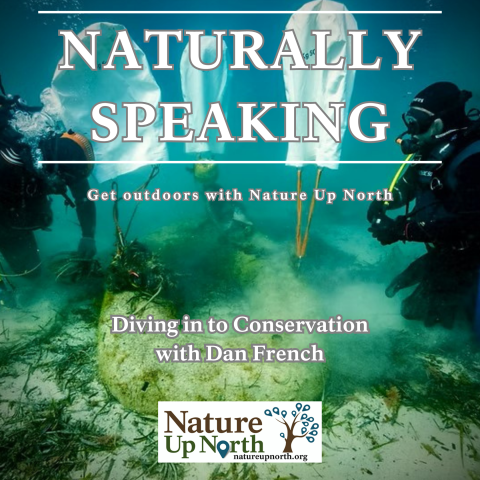
In this podcast, join Nature Up North Project Manager Dan French as he sits down with the co-founder and President of the Thousand Island Divers Alliance (TIDA) Todd Keister. Over the course of 35 minutes, Todd and Dan discuss the three pillars of TIDA's mission; safeguarding the ecological integrity, cultural heritage, and recreational value of the St. Lawrence River. Learn a bit about diving in the St. Lawrence River, the unique conservation work that TIDA is doing, and a couple of shipwreck stories from the local community. All this and more in this episode!
00:00:06 Dan French
Welcome back to another episode of Naturally Speaking. I'll be your host today, Dan French, project manager for Nature Up North, and it is my utmost pleasure to welcome Todd Keister to the studio today. Todd is the co-founder and president of the Thousand Island Divers Alliance, an organization based in Alex Bay, New York, that's working on ecological integrity, cultural heritage, and recreational value of the St. Lawrence River. Thank you, Todd, for joining me today.
00:00:29 Todd Keister
Thanks a lot. It's a pleasure to be here.
00:00:30 Dan French
We have a lot to talk about today, especially because I don't have a background in scuba diving. So I'm going to do a lot of learning on the fly as we talk here. But before we get into scuba diving itself, what caused you to found or co-found the Thousand Island Diving Alliance?
00:00:48 Todd Keister
Well, it's sort of a combination of things. Most of my dive training actually took place at the river. I grew up summering at the river. My grandparents had a place for years. So I've always had sort of a love affair with the river. And after diving so much in the St. Lawrence and seeing how beautiful it is, it just sort of, I don't know, a feeling of responsibility, I guess, that you have for preserving it. Maybe that comes with getting a little older too. And essentially, I know of a lot of individual divers, colleagues, and friends that I dive with, that people are individually interested in preserving the river and protecting it. But there was no organization to kind of channel all of those efforts into something where we could do something bigger, where we could cooperate with municipalities or other environmental groups and things like that. And of course, I was aware that some of the other environmental groups clearly don't have any underwater assets, right? So I figured that would be another area that we could help if we got this organization up and running.
00:02:05 Dan French
Definitely. And how did you get into diving personally?
00:02:09 Todd Keister
It was sort of a long journey for me to get into diving. I actually grew up petrified of the water. I had a sadistic swim instructor in the 70s in the YMCA that pretty much turned me off of water for a long time. I didn't learn to swim until I was about 13 years old. Wasn't really fully comfortable in the water until well into adulthood. And I guess diving was just something that maybe was the final step in getting over my fear of water. To the point now where I actually prefer to be underwater all the time if I could.
00:02:49 Dan French
I like to think I'm on a similar journey, though I'm not underwater yet. I still stay on top of it in boats and kayaks and canoes.
00:02:57 Todd Keister
Yeah, I understand that feeling.
00:02:59 Dan French
That's wonderful. So I want to get into what the Thousand Island Divers Alliance does as part of your mission as well. And the mission is to safeguard the ecological integrity, cultural heritage, and recreational value of the St. Lawrence River. Your website, tidivers.org, goes into a lot more detail about each piece of that. And I want to start with the ecological integrity. Before we started the podcast, you mentioned that was one of the key drivers of the founding of this organization. What does ecological integrity mean to you in the term, in the context of diving?
00:03:32 Todd Keister
Well, it entails quite a lot, really. It's not as simple as, you know, just removing trash from the river, right? Although that is one of the things that we do, one of the kind of unique things that we can provide, actually. But there's more to it. There's a lot of environmental monitoring that needs to go on, and a lot of that can only be done underwater. The New York State DEC does a lot of research, but they have limited diving assets as well. And they do have various listening stations and things like that sometimes
00:04:11 Todd Keister
drop off and they need help finding them. So we've offered assistance to them to be able to get, more bodies in the water if they need to locate, some of their listening stations and things of that nature. And also, of course, bass nesting sites and things like that, these are all underwater. So if you don't have, an entire squadron of research assistants that are also certified scuba divers, it's going to be more of a challenge. So we're able to offer those services as well.
00:04:42 Dan French
Awesome. I wanted to start with cleanups actually, because from some previous experience doing river cleanups in national parks, I know that sometimes there's a line between historic trash and modern trash. And that line has always been blurry to me. And I'm wondering if there's a distinction in the St. Lawrence that you try to follow. And of course, historic shipwrecks might be a clear historic piece, but how long does a boat have to be underwater before it's historic, you know?
00:05:12 Todd Keister
Exactly. Yeah. There is definitely a line there. And of course, there are certain types of materials that are more harmful than others, right? A glass bottle can lay on the bottom of the river for hundreds of years and isn't going to hurt anything. It might be aesthetically unpleasing to look at. Although that being said, sometimes it's very exciting for divers to find, we find a lot of the round bottom bottles from the 17th and 18th, 19th century, which are kind of exciting for some divers to find. You know, whereas, you know, vinyl siding and PVC pipe and things that can leach chemicals are much more concerning. So
00:05:53 Todd Keister
Basically, if there's a, car's been on the bottom of the river for 40 years, it's already done all the damage it's going to do. And they actually, some of them provide some nice artificial habitat for fish species, gives them some structure to get some shelter. So basically, we just tell our divers when we're out there looking for trash just to sort of prioritize, right? So we prioritize plastics and vinyls, you know, tires, vinyl siding, things of that nature, plastic bags, and then just sort of go down from there, right? So we find all kinds of stuff down at the bottom of the river.
00:06:31 Dan French
I think I saw a fridge in one of the photos someone had pulled up as part of a cleanup or something of similar size.
00:06:36 Todd Keister
Yeah, we found a refrigerator before. Our last cleanup, we pulled up a toilet, blades from a brush hog, a bicycle.
00:06:47 Dan French
When you're doing river cleanups, I mean, some of the debris is large, heavy.
00:06:51 Todd Keister
Yes.
00:06:52 Dan French
Do you, unless you're a strong man, I imagine there's some tools you might employ to help get some of these objects from the bottom to the surface.
00:06:59 Todd Keister
Yeah, as you can imagine, working underwater is exponentially more difficult than anything you do on the surface. Water is extremely dense. It's difficult to move quickly, right? You have to move in three dimensions.
00:07:14 Todd Keister
Some of the objects that we bring up at our cleanup dive, there was a 400 pound truck tire that we bring up, right? So nobody can carry that. Obviously, even underwater with the displacement, it's still far too heavy. So we raise larger items with what's called a lift bag. And they're essentially just giant balloons, right? Much more tougher than an ordinary balloon that you fill with air and get the object up off the bottom so that it's neutrally buoyant so that you can either push it and swim with it. Or what we did with some of the items was just simply send them all the way to the surface. And then we had personnel up there on jet skis that would then tow it to the shore. But those operations are a little more potentially dangerous because one of the most dangerous things that can happen to you as a diver is a rapid ascent.
00:08:12 Dan French
Okay. Even in the St. Lawrence.
00:08:14 Todd Keister
Oh, yeah.
00:08:15 Dan French
Okay.
00:08:15 Todd Keister
Yeah. Anytime you get any sort of depth, ascending rapidly can cause all sorts of problems from decompression sickness, which is known as the bends more commonly, or lung over expansion injuries and things like that. So, you know, we make sure that anybody that's involved in those types of operations have training and experience in using a lift bag.
00:08:40 Todd Keister
Yeah. on the surface, it doesn't seem like it's that potentially dangerous. But once you get down there, and if you know about scuba diving, you can see how...
00:08:48 Dan French
I believe it.
00:08:49 Todd Keister
Potentially dangerous it is. If you do it right, most like everything with scuba diving, right? If you follow the rules and do it right, it really isn't statistically dangerous, but there's a lot of potential danger.
00:08:59 Dan French
Definitely. Do you have a favorite relic or piece of trash, I suppose, that you've found?
00:09:08 Todd Keister
I don't know. Some people are fixated on the toilet. They thought that was really bizarre. I pulled up an old vacuum cleaner. Looked like it was from the 1960s.
00:09:19 Dan French
Interesting.
00:09:19 Todd Keister
Which was kind of strange to find at the bottom of the river. But I don't know if I have a real favorite necessarily.
00:09:25 Dan French
How far offshore do you go for cleanups?
00:09:28 Todd Keister
Generally, we're within, say 100 yards of shore most of the time, which is where you're going to find most of your debris, of course, right? Most of it has just been thrown in from shore. But I was talking to somebody the other day and they said that, was just sort of the way people got rid of things back in the 50s. they just put it on their boat and took it out to the middle of the channel and dumped it in the river thinking it wasn't going to hurt anything, you know? But yeah, so we definitely sort of have a hierarchy of what's important to take out and we just leave the rest.
00:10:03 Dan French
Monitoring. So there are some monitoring projects you're involved in, and I'd like to talk about the specific projects in a bit. But generally speaking, the monitoring that you do, you assist DEC and government agencies, local environmental groups. Are you responsible for any specific monitoring sites? Because I saw recently in social media that you were marking off some of those bass nesting sites that to me looked like incidental opportunities to do ecological help and monitoring of those species.
00:10:33 Todd Keister
Right, yeah, that was the video that you saw on Facebook about the bass nest that we found that was just sort of when we first started diving at the Islander site, we discovered that this fish, the smallmouth bass, had made a nest practically right off the entry point and right where people are always walking. And so we built something there to protect him and see if we can keep him safe in this 6 to 8 week vigil that he's got there. But that wasn't part of any official program or anything. Like you said, it was just sort of incidental. Our only official monitoring projects right now are the two project baseline activities that we have going on at the Islander wreck and then at the Key Storm wreck, which is much further up this way near Dark Island. Beyond that, what we're doing is mostly incidental. Like I said, we've been talking with the local DEC station, and then we're also discussing ways that we can help the Thousand Islands Biological Station, SUNY ESF. But we don't have anything official that we're doing for them yet at this point.
00:11:40 Dan French
This is a good lead-in to Project Baseline. And we were talking a little before we started. Is that a national program or an international program? What is Project Baseline?
00:11:50 Todd Keister
It's an international program that was started by divers, I believe, from Global Underwater Explorers, which is one of the many training agencies that exist worldwide for training divers.
00:12:06 Todd Keister
They tend to focus more on technical diving, but I believe they started this project and eventually it just sort of took on a life of its own. And it is itself a nonprofit and they basically just maintain these databases on all of these various underwater structures, whether they're shipwrecks or reefs and things of that nature and track them over time. So what we do is encourage divers when they go to the Islander, there's a sign there now with a QR code where they can upload their observations that they make. We have a visibility measuring station that we built there, so they can record visibility, water temperature, which their dive computer will give them, various fish species that they see there, or any photographs that they take of the wreck or things of that nature. And then we pass that along to Project Baseline, they put it in their database, and then it's available to anyone that wants to use it for research, et cetera.
00:13:00 Dan French
Yeah. And so the two active baseline sites are the Islander Cleanup and then the Key Storm, or the Islander Shipwreck and then the Key Storm Shipwreck.
00:13:09 Todd Keister
Key Storm wreck as well, yes. And now that's a work in progress. We've got approval to make it a project baseline site, but we haven't started measurements or measuring stations and things like that yet.
00:13:21 Dan French
Yeah. I was doing some reading. One of these two was a coal liner carrying coal when it shipwrecked.
00:13:26 Todd Keister
Yes, the Key Storm was a collier, which is just a ship that hauls coal. And it ran aground on Outer Skow Island Shoal, which I believe is in the town of Hammond, actually, back in October of 1912.
00:13:45 Todd Keister
They got lost in the fog, drifted out of the channel and struck the shoal, and eventually rolled off the back of the shoal and sank. Efforts were made to raise the ship, which failed. The cables are still down there that they tried to raise the ship with. Most of the cargo was salvaged, I guess, although there's still an awful lot of coal.
00:14:04 Dan French
You've seen it.
00:14:04 Todd Keister
In the holds and on the bottom, yeah. But I think they recovered the lion's share of it.
00:14:12 Dan French
Wonderful. And then the Islander, I'm blanking on what that ship was.
00:14:17 Todd Keister
That was a, it was built in 1861 in Rochester and was originally a mail carrier among some other things. Changed hands a few times and eventually became the Islander and was one of the very first tour boats in the region.
00:14:35 Dan French
Oh, wonderful.
00:14:36 Todd Keister
Tourism suddenly became a thing around the turn of the century. And it was moored at the Cornwall Brothers pier there in the village when it caught fire in September of 1909 and burned close to the water line and sank. So it's very close to shore, which is one of the reasons it's such a popular dive site.
00:15:00 Dan French
You mentioned that some of these sites serve as, I'm going to say artificial reefs, that we don't have reefs in the San Lawrence, but artificial habitats for fish and other wildlife. And that falls under the protection arm of the ecological integrity work that you folks are doing in my mind. The bass nesting protection, is there other work that the Thousand Island Divers Alliance is doing to protect the ecosystem that's there?
00:15:27 Todd Keister
Other than the cleanups and just monitoring conditions generally, we don't have any other specific programs that are in place this year anyway, in terms of artificial structures and habitats for wildlife. We are looking at maybe next year creating artificial or pre-arranging, I guess, nesting sites for bass to see if there's any utility to that.
00:15:56 Todd Keister
which is something we'll discuss with DEC biologists over the summer and decide if that's something worthwhile for our divers to get involved in.
00:16:05 Dan French
That's exciting. It sounds to me like there's a lot of positive reception from local groups in the area to the creation of this organization.
00:16:13 Todd Keister
I've been really pleased and surprised, frankly, that the level of enthusiasm, right? I spend my winters in Florida now. I'm retired, but I came up this winter for meetings with the Village of Clayton and Alexandria Bay boards. And the mayors there, Mayor Hyde in Clayton and Mayor Putnam and Deputy Mayor Fulmer in Alexandria Bay have been just nothing but supportive, really enthusiastic about the ideas that we've had. They're supporting our diver down flag awareness initiative as well. So it's been great. And local businesses have been fairly supportive as well.
00:16:55 Dan French
That's wonderful. Cultural heritage. Not something I typically think of and associate with scuba diving in my mind. But as I was reading about the organization, it's occurred to this is something that's almost like integral as part of the activity, especially in this area with shipwrecks, trash, frankly, being left behind, finding relics amongst that. When you were co-founding this organization, what does cultural heritage look like to you and the Thousand Island Divers Alliance?
00:17:26 Todd Keister
Yeah, it's mainly the historical aspect, of course, right? There's A tremendous amount of history in this region, going back to the earliest explorers from Jacques Cartier discovering, quote unquote, the St. Lawrence River and naming it. And then of course, all the War of 1812 history, and then there was some other episodes during the Patriot War in Canada, right? And a lot of that history really goes unnoticed, right? But it's been such an important maritime commercial waterway for centuries that as a result of the treacherous nature of the river, especially before the Seaway went in, it just so happens that there's an awful lot of shipwrecks dating back to the 18th century and the Seven Years War, or the French and Indian War, as we call it here. And so that's obviously the cultural heritage that we're focused on. Although there is an awful lot of other interesting history here that we hope to highlight more as we go forward and do more things like blog posts and then things of that nature.
00:18:45 Dan French
I have some family in the area, so I'm familiar with shipwrecks, anecdotally. As I was preparing for this, I was wondering if you've ever discovered things that predate European settlement historically in the water or anything like that?
00:18:57 Todd Keister
Nothing that I've ever personally discovered or had anybody find on a dive. Most of the things that we tend to find are, you know, from the last 200-250 years.
00:19:10 Dan French
Things that would stick around for that long.
00:19:16 Dan French
All right. How many shipwrecks have you visited?
00:19:20 Todd Keister
Me personally, probably only maybe 10 of the area shipwrecks. And there are dozens. And they range from completely intact vessels or nearly intact vessels all the way to the Iroquois, which was a French-built warship that sank at Niagara Shoal near Fisher's Landing, back, don't quote me, but I believe in the 1760s, it would have been, because it was during the Seven Years War. It was captured by the British and burned. But its remains are still there, although it's really just a keel and ribs. But it's been studied and they've verified that it is, in fact, the wreck of the Iroquois, based on the way it's constructed and the spacing of the stays and things of that nature.
00:20:21 Dan French
Interesting.
00:20:21 Todd Keister
Yeah, it's really fascinating.
00:20:23 Dan French
Do you have a favorite shipwreck?
00:20:26 Todd Keister
It's hard to say. I probably have to say my favorite is the wreck of the Vickery. The AE Vickery sank out in front of Rock Island Lighthouse, back in the late 19th century. And it was a really large three-masted schooner, and it's still pretty much remarkably intact. The windlass on the front is still intact. It was carrying corn to go to the Prescott Distillery, which I believe is still there, when they just drifted out of the channel and struck the shoal there and sank. There's actually quite a story there. They had just picked up a river captain in Clayton, and maybe 15 minutes later, the river captain drove him right into the rocks. And the captain reportedly pulled a pistol and was going to shoot the captain, he was so enraged. And the captain's brother happened to be on board and supposedly knocked the pistol out of his hand and it went overboard. So everybody's still looking for that gun.
00:21:34 Dan French
Is that the off the shore of Thousand Island Park proper? There's that red lighthouse. Is that where that location or is that a different lighthouse that I'm thinking of?
00:21:44 Todd Keister
If you're thinking of TI Park on Wellesley Island.
00:21:47 Dan French
That's the one, yeah.
00:21:48 Todd Keister
Straight across, there's a white lighthouse.
00:21:51 Dan French
White Lighthouse, yeah.
00:21:52 Todd Keister
Rock Island, and it's right there.
00:21:55 Dan French
Recreational value is the final cornerstone of the mission you have there. You highlighted the dive flag awareness campaign that you're involved in. There's also a underwater navigational course that you constructed that as part of certifications, it sounds like, for other dive schools that are looking for a place to do their navigational training as part of their certification.
00:22:18 Todd Keister
Yes.
00:22:19 Dan French
Let's start with the dive flags, because it's something that I'm familiar with, and I have my boating license, but I probably need a refresher. What does the dive flag look like?
00:22:28 Todd Keister
The dive flag is just a solid red flag with a diagonal white stripe.
00:22:33 Dan French
So what rules are associated with that flag? What should people be aware of?
00:22:36 Todd Keister
Well, of course, what the flag means is that diving operations are actively underway. It shouldn't be displayed unless there are actually divers in the water. And under New York State law, you're required to stay at least 100 feet away from the dive flag, although it's recommended to stay 300 feet away, just for safety's sake. And that way you can avoid collisions between divers and boaters.
00:23:02 Dan French
Definitely. And what work is the TI Divers Alliance doing to promote the flag and awareness about that?
00:23:08 Todd Keister
Our main focus is putting up educational signs. We have 12 by 18 inch street signs, basically, that we have been able to purchase with a generous grant that we got from Stewart's Shops to cover that. And we're just contacting different municipalities, parks, resorts, things like that, and asking them if we can install these signs to educate boaters. We're trying to focus on places that have a lot of rental boating activity. Or you have a lot of people that aren't very well familiar with boat operation, right? So that they can see, get this information right as they're getting into their boats. So we're just trying to push those signs out there. We've, like I said before, we've gotten a lot of cooperation from the villages of Clayton and Alexandria Bay. We're going to be approaching Cape Vincent because they have a very busy boat launch there, especially during their bass tournaments and things like that. Beyond that, we may look to do additional things in terms of public education online or otherwise as part of maybe a program for next season as well.
00:24:26 Dan French
The underwater navigational course, I watched a video on your website of someone actually swimming it. And that's something that you built, you said, six years ago.
00:24:34 Todd Keister
Yes, yep. I'm an independent scuba instructor. I contract generally up here with St. Lawrence Scuba in Watertown. And that is something I built for part of the advanced course. The advanced open water course, one of the things that you're required to do is a navigation dive. And so what we wanted was something that was a little more challenging than simply swimming 300 feet in one direction and coming back. That's not really navigation in our view. So with help from a couple other divers here and there, over the course of probably 2 summers, because I kept expanding it, we eventually built this course that covers a couple of acres underwater. And it's a good challenging course for the students and really help build their confidence of navigating underwater. The Divers Alliance is sort of, not taken ownership, but sort of adopted it as something. So we'll keep it, help to keep it clean. The underwater waypoints have to be cleaned off. And every spring, we have to make sure that all the waypoints are in the right place and didn't get caught by a fishing line and dragged 10 feet out of position or something.
00:25:50 Dan French
Wonderful. Are there any other projects you folks are working on with recreational value or promoting diving particularly?
00:26:01 Todd Keister
In terms of promoting diving in the region, at this point, like you said before, we're a relatively new organization. This is our first operational season. So we're focused on trying to build up our capacity a little better, but we are making efforts to promote diving in the region in general. We are in contact with some other diving groups downstate, people that don't tend to come up here very often or don't know about the diving opportunities up here. That's the thing I've been most surprised with. At that Islander diving site, it's right by the Riverwalk. So anytime you go down there and dive, you always wind up being sort of a tour guide and ambassador for the entire scuba industry of people asking questions about, you know, what's out in the water and why are you going in the water. And I've been very surprised at the number of people that have come by told me that they were visiting town and that they're scuba divers and that they had no idea that you could scuba dive on the St. Lawrence River. So we're trying to get the word out on that. But that's an effort mostly within social media and things like that. But we hope to kind of expand that a little bit and make more contacts.
00:27:17 Dan French
Definitely. So you mentioned this area where people are, tourists are coming in, they're interacting with you, asking questions, as divers under the water. And that's the entrance to the Islander site?
00:27:27 Todd Keister
Yes.
00:27:28 Dan French
And it's my understanding that there's going to be a lot of work happening at that site in the future as far as beautification or repairing some of the launch there.
00:27:38 Todd Keister
Yes, yeah. We've partnered with the village of Alexandria Bay to sort of improve the entire setup there. For years, it's been a sort of village-owned property, which is sort of an ad hoc ramp to allow access into the water. But there's nothing there specifically to make it into a destination or a dive park, if you will. So we approached the village over the winter with our project idea, which they were very enthusiastically supportive of. And eventually I was told of a grant opportunity from the Jefferson County Visitors Investment Fund and asked to submit a grant on behalf of the village which we were actually awarded a couple of weeks ago. So it's a $25,000 grant from the Visitors Investment Fund matched by some funds from the village and a tiny bit of funds actually from our organization. And it's going to entail building a very large 12 by 16 foot deck there with benches for divers, places for them to store their gear, and a resurfacing of the ramp and placing no skid sort of serrated aluminum stairs at the bottom to make it much safer for divers getting in and out as the current ramp is very slippery.
00:29:02 Todd Keister
So there's been a lot of...
00:29:05 Dan French
You speak from personal experience.
00:29:09 Todd Keister
Luckily, knock on wood, I'm not one of the victims yet, but I've seen a few people go down there. So it's going to be it's going to be much nicer. It's going to reduce clutter and congestion along the Riverwalk, which passes right through there, and along with some signage, and we're hoping to get a sponsor for some landscaping and beautification there. We hope to turn it into a dive park rather than just a spot you can park your car and slide down a slippery ramp and bring more tourism and benefit to the village of Alex Bay as well, as well as move our projects forward.
00:29:47 Dan French
Where in Alex Bay is the site right now?
00:29:50 Todd Keister
The address is actually 35 Market Street. There's nothing there, obviously. It's just a vacant lot, but it lies directly between the Cornwall Brothers Store Museum and the River Hospital.
00:30:01 Dan French
Okay, nice. You mentioned, so the Alex Bay is supporting this project financially. Stewart's has donated to you for other projects. Are there other major contributors to the project?
00:30:14 Todd Keister
The Northern New York Community Foundation was actually the first to invest in us, and they were generous enough to give us a grant to help us with volunteer training and safety materials. So we were able to obtain first aid kits, automatic external defibrillator, printing costs for safety manuals and things of that nature that those funds allowed us to get to help our divers stay safe when they're doing these operations. Yeah.
00:30:44 Dan French
Definitely. And are there other maybe non-financial contributors, but partners we haven't had a chance to mention today, talk about the DEC, other groups like that?
00:30:53 Todd Keister
Yeah, the DEC has been very helpful. We've reached out to the Thousand Islands Land Trust that indicated they're very enthusiastic about doing something with us. They had apparently reached out to someone in the past and it kind of never got anywhere, but we hope to be able to do something worthwhile with them. We are partnered with Save the River. We're going to be assisting them at their scheduled cleanups over the summer so that they'll have underwater assets for the first time on their cleanups. And we've gotten good support from the local dive community as well. St. Lawrence Scuba Company and Watertown provided us a number of things for our cleanup dive. All About Scuba and Hunt's Dive Shop are more local up in the Thousand Islands. They've been helpful in kind of promoting what we're doing and supporting our work. So I've been, like I said, really pleased with the response we've gotten from everyone.
00:31:52 Dan French
That's fantastic. As I was walking Todd out, he also wanted to mention SLELO PRISM, which is the St. Lawrence Eastern Lake Ontario Partnership for Regional Invasive Species Management. They are another key contributor and partner for the Thousand Island Divers Alliance.
00:32:09 Dan French
If people want to find the Thousand Island Divers Alliance, it's tidivers.org. Are you the same name, Thousand Island Divers Alliance on social media? Where can people find you and how can they get in touch?
00:32:19 Todd Keister
Yes, we're the same name, Thousand Islands Divers Alliance on Facebook and Instagram as well. So you can find a lot of information about the projects we're working on and ways that you can get involved by joining, donating, coming to an event, et cetera.
00:32:35 Dan French
Do you have to be a diver to join the Alliance?
00:32:39 Todd Keister
No, not at all. We have a need for volunteers to do all sorts of things. We need topside support at any of our dives, especially cleanups, because we need people to sort of help, you know, pull objects out of the water once they're brought to the surface. At our cleanup a couple of weeks ago in Alexandria Bay, we actually had our sponsor, which was Brian Wykoff, State Farm Insurance, both him and the Monster Energy drink representatives that were there, all three of them were all out on the shore and pulling in garbage. But yeah, so we need people to help us with things like social media posts, you know, topside photography and video, things that just the board members and divers, frankly, can't do right? Because they're busy underwater or doing other tasks. So anyone can join and be part of it. There's paid memberships. You can also sign up just to be on an e-mail list, just so you know when events are coming up and things like that. So we encourage anybody that cares about the river to, you know, go to our website and look and see about, you know, making a donation or becoming a member.
00:33:51 Dan French
Perfect. Well, thank you very much, Todd, for coming out to take a trip to Canton today to speak with me and share some of the wonderful work that you, your partners, and the Thousand Island Divers Alliance are doing in North Country Nature in the St. Lawrence River. It's been great talking with you.
00:34:05 Todd Keister
Absolutely. It's my pleasure. Thanks.
00:34:07 Dan French
Well, thank you for tuning in to another episode of Naturally Speaking. I was your host, Dan French, project manager for Nature Up North, and I had the pleasure of being joined by Todd Keister, president and co-founder of the Thousand Island Divers Alliance based in Alex Bay, New York. Stay tuned for additional episodes of Naturally Speaking coming out soon, and don't forget to get up and get outdoors with Nature Up North.