
Don't Flee from the Fleas
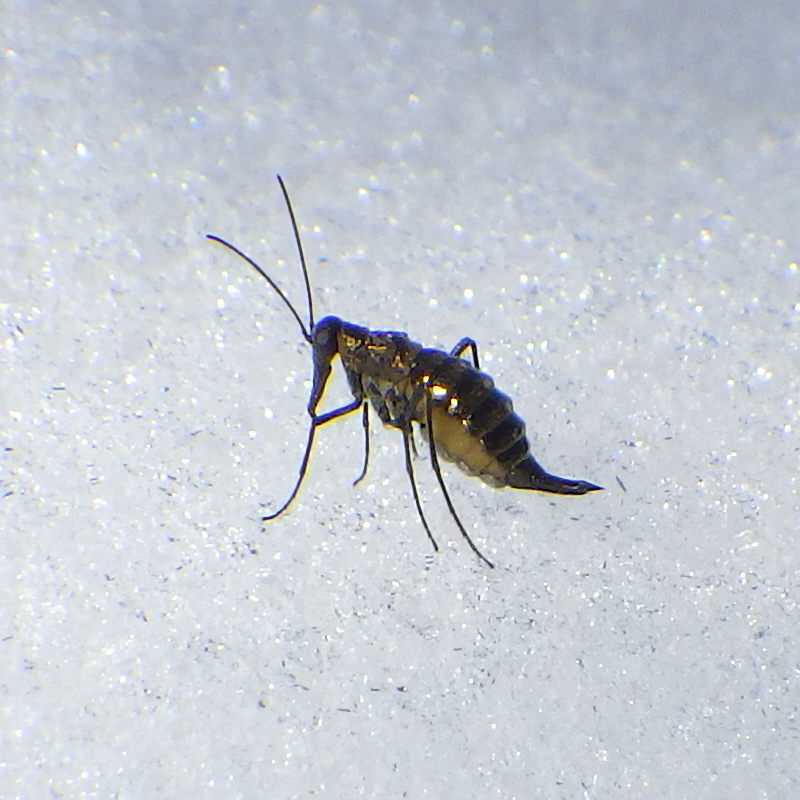
If you tromp around in the woods during winter, especially on mild days, you may notice dark specks collecting in depressions in the snow. If you look closely you’ll see these little pepper flakes bouncing around. They’re called snow fleas, but don’t panic—they’re not real fleas.
They’re not especially fond of snow, either, but other than that, snow fleas are aptly named. On sunny days in late winter they often congregate near the bases of trees or collect in footprints. While snow fleas are the size of actual fleas, they haven’t the least interest in you or your pets, but please don’t take that personally. Try not to step on them, as they may give us the means to improve both organ transplantation and ice cream.
Snow fleas, a type of “springtail,” were classified as insects until recent DNA sequencing pegged them as another type of arthropod called a hexapod. Apparently there’s now heated debate as to whether springtails constitute a hexapod class or merely a sub-class. You have to love scientists. First they study an obscure organism to develop life-saving technology, and then they come to fisticuffs over what to call it.
Whatever their label, snow fleas are beneficial in many ways. As decomposers of organic matter, they help create healthy topsoil. They and their hexapod cousins are one of the most abundant types of soil “animals,” numbering around 100,000 individuals per cubic yard of topsoil.
Besides eating algae, fungi, nematodes, protozoa and a wide range of organic matter, they consume organisms and spores that cause damping-off wilt and other plant diseases. In fact, springtails are being studied for their potential to control disease in greenhouses.
Snow fleas also produce a unique glycine-rich protein that keeps ice from forming inside their cells even at very cold temperatures. This newly discovered molecule is unlike any previously known protein, and is the basis for research on more efficient storage of transplant organs. Organs could be stored for much longer if this protein allows them to be kept at below-freezing temps without damage.
A slightly less important application, but a welcome one to many, is that snow fleas could improve ice cream. Eventually we may see ice cream that never forms ice crystals no matter how long it sits neglected in the freezer.
Springtails lack a respiratory system and must breathe through their skin. As a result, they’re quite vulnerable to drying out, and hop around to find moist, sheltered places as well as things to eat.
A true flea uses its tarsi, or toes, to vertically jump as much as seven inches, roughly equivalent to someone leaping 500 feet straight up using only their toes. A snow flea, however, is not nearly so athletic. It can use its two tail-like appendages to bounce a fraction of a flea-jump, comparable to a human leaping a mere dozen feet in the air. I feel so much less inadequate now.
During warmer months, snow fleas and other springtails are more active than in winter, though without a snowy background for contrast they’re hard to see. They forage extensively in the humus layer and
move throughout the soil profile, even quite deep. Springtails can be found up in the forest canopy as well as on water, where surface tension keeps them from sinking. If you go out with a flashlight some June night you can see springtails bopping about on standing water.
Just hearing the word “flea” can set folks on edge and start them scratching, so it’s unfortunate about snow fleas’ name. Think of them as springtails, and keep an eye out on bright winter days for these jittery critters that help create topsoil, and could one day help save our life. Or at the very least, our ice cream.

Paul Hetzler is the Horticulture and Natural Resources Educator for Cornell Cooperative Extension of St. Lawrence County.