
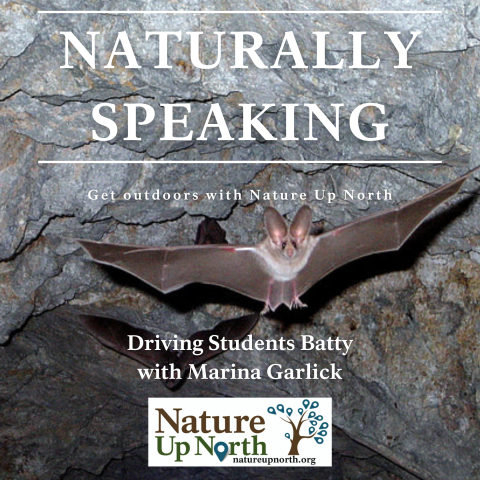
On this episode of naturally Speaking, join host Marina Garlick in a conversation with a Conservation Biology fellow Jessica Harmen discussing her research of bats in the North Country. Specifically, they dive into the intricacies of how bats are researched. As well as the different types of calls that they make. Through this conversation, they highlight how bats are interesting animals that are facing real conservation challenges and are not as intimidating as the media makes them out to be.
00:00:00 [theme music]
00:00:15 Marina Garlick
Hi everyone and welcome back to another episode of Naturally Speaking. I'm your host Marina Garlick and today I'm going to take you under my wing to explore the mysterious and largely misunderstood world of bats in the North Country.
00:00:29 Marina Garlick
I'm joined by Jessica Harmon, a research fellow from St. Lawrence University. This summer, she is conducting mobile acoustic surveys of the bat species abundance and richness. Together we will soar through the particulars of the diversity, health and monitoring research of the bats that live right in your backyard. Let's get into it.
00:00:52 Marina Garlick
Hi, Jessica. How are you doing today? Good. Would you mind introducing yourself a little bit for our listeners?
00:00:58 Jessica Harmen
Yeah. So my name is Jess, and I'm a Conservation Biology major at St. Lawrence University, and I'm doing research on bats this summer.
00:01:08 Marina Garlick
That's so cool. What? Professor are you working with?
00:01:10 Jessica Harmen
Erica Barthelmess.
00:01:12 Marina Garlick
Oh, that's so cool. For those of you who don't know, Erica Barthelmess is the founder of natur up North, and she founded us 12 years ago. But she's been with St. Lawrence for about 26 years, which is crazy.00:01:24 Jessica Harmen
Wow.
00:01:25 Marina Garlick
Yeah, she's a staple of here. So you're saying you're doing research on bats, right? Yes. Awesome. And what interests you about bats?
00:01:33 Jessica Harmen
Well, Oh my gosh, they're just so fascinating. Cause you never really see them. And there's all this stigma around them. People really don't like them. They think they're gonna get caught up in your hair all all kinds of messed up and and give you diseases and stuff. And but they're so elusive and I think that's really, really fascinating about about them. Yeah, they're misunderstood.
00:01:54 Jessica Harmen
But then you know the average person won't really see them.
00:01:59 Marina Garlick
Yeah, I think that is definitely part of the mystique of that. And I really see a lot of that in media as well, around bats.
00:02:05 Marina Garlick
Specifically, what are you researching about bats specifically?
00:02:10 Jessica Harmen
Specifically I'm doing mobile acoustic surveys of bat abundance, and bat species abundance and richness in St. Lawrence County. So I'm just, I'm just recording them so I don't. I don't do any hands on kind of work with them. I'm just you know, listening to what they're saying.
00:02:31 Marina Garlick
That really interesting. I'd love to hear more about your research, but first I think our listeners would like to know what kind of bats there are in the North Country. According to the New York Department of Environmental Conservation or the Dec, there are 9 species of bats in New York, 6 are cave dwelling, and three are tree dwelling. What would you like to add about these species specifically?
00:02:51 Jessica Harmen
Yeah. So. Tree bats. A lot of people don't know. But, you know, bats.
00:02:55 Jessica Harmen
These species, they live in trees and they migrate in the winter, so they don't hibernate and the three tree species I have my list here. We have the Horry bat, the eastern red bat the and the silver haired bat and those are tree species.
00:03:09 Jessica Harmen
And then our cave species, we have big brown rats, little brown bats, small footed bats, northern long eared bats, tricolored bats and maybe Indiana bats. They're endangered, so not really sure about that one.
00:03:22 Marina Garlick
Indiana bats are endangered in New York, and there has been efforts over the past few decades to protect their hibernation sites. And this is because there are two hibernation sites within New York, in caves that house more than half of the population of Indiana bats, and thus if those caves get infected with white nose syndrome, then that would devastate the population even further. So there's been efforts to block in those caves, like with gates, so that humans don't enter them and to work in tandem with land owners and other land trusts in New York to protect these bats.
00:04:06 Marina Garlick
Now back to the tree, bats, I didn't know that some bats migrate. Where do they migrate to?
00:04:13 Jessica Harmen
Just you know South.
00:04:14 Jessica Harmen
So no, I don't know too much.
00:04:15 Marina Garlick
No, that's super neat. I I feel like we talk about like birds migration a lot and our best part of the bird species or are they mammals? There's flying mammals.
00:04:23 Jessica Harmen
They're mammals. Yeah.
00:04:25 Marina Garlick
Yeah, just flying mammals. Yeah, that's so cool.
00:04:28 Jessica Harmen
Rats with wings. And my dad calls them.
00:04:34 Marina Garlick
That's awesome. What would you say? Like the most common bat up here? Like, if you were or like a bat, you're most likely if you were to see a bat, what bat would it be?
00:04:46 Jessica Harmen
Well, I don't know. I feel like people get big Browns and little Browns in their houses a lot. Yeah, people would see them most often, and I think they're the least afraid of humans and the most likely to come near, but yeah.
00:05:01 Marina Garlick
Yeah. Interesting. So you're saying you're doing acoustic richness and abundance. Right? 00:05:08
Yeah.
00:05:08 Marina Garlick
OK, what? What does richness mean?
00:05:10 Jessica Harmen
Richness is just how many species we're able to record and then abundance is like how many of each species we're able to get. So we're seeing how many of these nine species of bats are we going to be able to get recordings of and?
00:05:25 Jessica Harmen
And how many individual bats can we? Can we find also?
00:05:30 Marina Garlick
Ah, that's cool. What have you found so far this summer?
00:05:33 Jessica Harmen
Haven't analyzed it yet, but you know, just just getting the recordings, getting out and driving that. We're at the collection phase of the research. So more to come. You know. Yeah.
00:05:43 Marina Garlick
That's awesome. Are you doing this research by yourself like has? Is it like an ongoing body of research or like an individual project for the summer?
00:05:52 Jessica Harmen
Well, Erica had this project going about 10 years ago, but and we're doing the same routes. That we that we drove 10 years ago, I wasn't. I wasn't here. But you know. But she unfortunately she lost the data from 10 years ago, but we're kind of continuing the project and doing it the same way that it had been done. So I'm kind of picking up what other people have already laid down and working from there.
00:06:17 Marina Garlick
That’s awesome. So what does like? A day in the life of a bat recording biologist look like yeah.
00:06:25 Jessica Harmen
OK, day in the life I could do a day in the life, so I wake up at around noon because I've been out late doing my survey the night before. And then I come in to the lab and I get my, I have my laptop that all my recordings are on.
00:06:41 Jessica Harmen
And then I put the data from that like the GPS files for where the recordings are, where we get each like individual bat. It'll it separates the recordings for you. So you don't have to sift through and find the bats. It's just boom, there was sound here and where was that? And so I have the file.
00:07:02 Jessica Harmen
For the sound and I have the file for the GPS and I take that file and I make sure it's labeled properly because I'm not labeling properly at at midnight the night before and then I put that onto a hard drive and I put that on to the other computer. So we make two backups of it.
00:07:18 Jessica Harmen
And then I write down. I have a sheet that I fill out with like the weather and like barometric pressure and all this stuff. And then I write that up onto the computer also. And just to keep track of data. So I'm doing during the day data analysis and then I'm what I'm going to start doing is analyzing the bat calls for what species we're actually getting.
00:07:39 Jessica Harmen
And that'll be something that I'll do during the day. And I've actually started doing that a little bit. I run it through this, this program called Kaleidoscope Pro. And it has an AI that will tell me what species I'm getting.
00:07:59 Jessica Harmen
And then I just export that spreadsheet and I've started saving those so gonna collect that and then so during the day I'm doing all that stuff, doing all the data, crunching the numbers, and then I get a little break, I get my dinner and then I go out at about 8:00 and then I do my, So then it's sunset. It's been around 8:48 for sunset.
00:08:21 Jessica Harmen
Recently and then 30 minutes after sunset, I get to my route, my spot where I'm supposed to go, and we start exactly 30 minutes after sunset, every every night, and I sometimes I'm alone. Sometimes I bring a friend and I go out and I do the route 18 miles an hour. Woohoo.
00:08:42 Marina Garlick
Whipping it along the road. That's awesome.
00:08:46 Jessica Harmen
Yep.
00:08:47 Marina Garlick
And are you doing different routes each night, or is it the same route each night?
00:08:50 Jessica Harmen
Yeah. So we have a quite a few routes that we're working on. We have them split up into agriculture and I don't know. So like deciduous forests and something else, I've only just done the agriculture one because I've just finished up. We did some surveys for the DEC.
00:09:08 Jessica Harmen
That were their own kind of routes, and now I'm just getting into the ones.
00:09:12 Jessica Harmen
Where we're labeling them differently and they're they're our own routes that we actually created, so.
00:09:18 Marina Garlick
That's so cool. Do you because you're using the same routes that were designed 10 years ago, right? Do you know what goes into, like designing a route to survey bats?
00:09:27 Jessica Harmen
You know, I don't know all that much about GIS. Erica did it all for me. Shout out Erica.
00:09:33 Marina Garlick
Yeah, absolutely. You know, that's so cool. I gotta corner her later to ask her about that?
00:09:38 Marina Garlick
Hmm, cool. And then you get to bed like, super late. How long does like a recording usually take if you're starting at, like, 9:00 PM?
00:09:47 Jessica Harmen
It depends on how long the route is, but usually I'm home at like 11:30, midnight. You know, that kind of region.
00:09:59 Marina Garlick
And do you get any nights off or is it just seven days a week?
00:10:03 Jessica Harmen
I get weekends. And and if there's rain, we can't go in the rain.
00:10:09 Marina Garlick
OK, so it's all the random thunderstorms we've been having.
00:10:12 Jessica Harmen
Yeah, those nights I'm not out with my recorder.
00:10:15 Marina Garlick
Is the recorder like Mountain on top of the truck or is it like out the window
00:10:23 Jessica Harmen
Mm-hmm. So it's plugged into the laptop and then that cord goes out the right passenger window and the recorder is huge. It's like.
00:10:29 Jessica Harmen
The size of I guess of football, so not too big, but then you put that over the passenger side door. Mm-hmm. And it magnets to the top of the car on the passenger side.
00:10:40 Marina Garlick
And you're only going 18 miles an hour. You're not going very fast enough to like mess with the magnets.
00:10:44 Jessica Harmen
Yeah, that's not gonna fly off. It's a strong magnet, too. I don't think it would. That's it's hard to get on there. It's hard to get off, you know?
00:10:55 Marina Garlick
Yeah, that's crazy. And when you're getting like, these recordings in, could you hear any of these sounds with, like, just your ears or are they too high pitched for humans to hear?
00:11:04 Jessica Harmen
Ooh, good question. So they're too high pitched for humans to hear usually, but with the laptop open in the passenger seat, I can hear like it. It'll pitch it down to a frequency that humans can hear it at, and I can hear it in real time as we're recording. Just really cool, it sounds like. [makes bat noise]
00:11:20 Marina Garlick
Ohh.
00:11:23 Jessica Harmen
And sometimes you get. That's just the regular the the call and and and each recording is is called the Bat Pass. When we. So when we get a bat pass, it's either a a call or you. Sometimes you get a feeding bus and. Then they're like. [makes another differnt bat noise]
00:11:41 Jessica Harmen
I'm not a very good bat.
00:11:44 Marina Garlick
I think you're a great bat, honestly, pretty impressive. Let's take a second to listen to some audio recordings of Big Brown bat passes. So first, let's listen to the Big Brown bat call.
00:11:58 [Big brown bat call]
00:12:06 Marina Garlick
And now comparing it to the feeding buzz of also the big brown.
00:12:11 [Big brown bat feeding buzz]
00:12:22 Marina Garlick
Isn't that so cool? The difference?
00:12:24 Jessica Harmen
It speeds it speeds up towards the end of the call, and that's them echolocating and zooming in on their prey item and maybe catching it as they get closer to it. They speed up their their call so they can see it better. I see it in air quotes
00:12:40 Marina Garlick
Yeah, that makes sense cause like it's, if you're you're narrowing in your focus from, like, a wide focus of the echolocation of like oh, there's an object here and then you get closer and so those calls are coming back quicker and quicker and closer to the object.
00:12:53 Jessica Harmen
Exactly.
00:12:55 Marina Garlick
That's so neat.
00:12:56 Jessica Harmen
More and more feedback and then you get it.
00:12:57 Marina Garlick
Yeah, hopefully.
00:13:00 Marina Garlick
Mm-hmm. Hopefully for the bats. You were saying there was like, a feeding call. And then just like a regular pass call.
00:13:07 Jessica Harmen
Yeah.
00:13:08 Marina Garlick
When you get the like pitched down version, are you like have been able to distinguish between the different types of bats when you hear them or do they all kind of sound the same.
00:13:15 Jessica Harmen
So you can hear when some of them are kind of higher pitch and then some of them are kind of lower pitch and you can go OK, so that's a high pitch bat that's a low pitch bat and but.
00:13:26 Jessica Harmen
That you can't really. You can't figure out the species. Just from that, you can just be like, OK, so this was.
00:13:32 Jessica Harmen
It was a low one, so it's probably like a Hoary bat and and you can kind of do that, but it's it's really quite hard to identify bad species from their calls. It's they're very, very similar. You have to really get into the minutia of like this initial lip of that, you have to analyze the shape of it in the. In the spectrogram it's just.
00:13:57 Jessica Harmen
It's really quite hard. So we have the AI helping us out.
00:14:00 Marina Garlick
There. Yeah, for sure. That's super helpful, especially with like a detailed assessment, probably some sort of calculus involves. Yeah, that's super cool.
00:14:12 Marina Garlick
How are the bats doing generally in the North Country?
00:14:16 Jessica Harmen
Ohh, how are they doing?
00:14:18 Jessica Harmen
Well, you know, to get into white nose syndrome a little bit that that is a fungal disease that came over from some country and and and started infecting bats here in New York State in the in the eastern US in 2006 was the 1st white nose infection and since then, bats up here have not been doing great. To my understanding, there's a few species that have lost like.
00:14:47 Jessica Harmen
90% of their populations, it's just. Oh, it's rough for them and.
00:14:53 Jessica Harmen
You know, there's things like like habitat loss and the oh, what are those, those, the windmills? Those things?
00:14:58 Marina Garlick
Yeah, like just windmills.
00:15:01 Jessica Harmen
Yeah, that's what they're like.
00:15:05 Jessica Harmen and Marina Garlick
Ohh wind turbines.
00:15:06 Jessica Harmen
Yeah, like yeah, not just that your windmill. Your windmill in your backyard isn't gonna do it, but the the turbines. Ohh, they're taking out bats. Yeah, there's a lot of threats that bats face in our area and.
00:15:19 Jessica Harmen
Yeah. So they're, they're not doing, they're not doing too great, but that's what we're going to try and assess with the research is you know, what's what's here, how are they doing? No one's really done this kind of thing in our region too much before. So this is kind of a preliminary, like, OK, let's assess.
00:15:38 Jessica Harmen
How are bats in Saint Lawrence County doing?
00:15:41 Marina Garlick
Yeah, that's awesome. And you said that there was some like research you guys were doing with the DEC yeah, and what's the DEC working on like, are they working on a more like large scale bat assessment?
00:15:52 Jessica Harmen
Yeah, I to my understanding, I think that they were doing just all over New York. They had people out doing surveys and they had standardized, of course, how you're going to do it and it's kind of a, I guess citizen science project, but yeah.
00:16:08 Jessica Harmen
That goes into it, so maybe not so much citizen science, but.
00:16:13 Jessica Harmen
Yeah, it was the same general idea as what they had us doing.
00:16:15 Marina Garlick
That's super cool. Yeah. Do you know if if for any?
00:16:21 Marina Garlick
Conservation efforts are happening in the area or is it mostly like trying to figure out what's going on with the bats at this point?
00:16:26 Jessica Harmen
You know, I'm not really sure I know well, the DEC doing their monitoring efforts.
00:16:34 Jessica Harmen
I don't really know that there's much in our really local area in in the way of bats. I've not heard much.
00:16:41 Marina Garlick
Yeah.
00:16:42 Marina Garlick
Cause St. Laurence actually has a bat house up by the sustainability farm or where the sustainability farm used to be, like out by the Living Lab building.
00:16:52 Jessica Harmen
I didn't know that.
00:116:54 Marina Garlick
Yeah, I didn't know either. I was on like, canoeing on the Little River. I was like, what? I need to reach out to doctor Ashpole. I was like, wait, is there a bat house?
00:16:57 Marina Garlick
But apparently it hasn't got an activity yet. Ohh bummer. Sad.
00:17:10 Marina Garlick
If you were about looking for a house, where would you want your bat house to be? Cus we have a bat house like nature up north of the Bat house.
00:17:20 Jessica Harmen
Ohh, I don't. I don't know. I you know I'm not a bat. It depends what kind of bat. I don't know if The Cave bats or the tree bats have a different. Yeah.
00:17:27 Jessica Harmen
Are they both using the bat boxes? I don't know.
00:17:31 Marina Garlick
Yeah, because I can imagine, like a cave bat, it's a little. That would be suspicious of the Bat house because it looks more like a tree.
00:17:34 Jessica Harmen
But if I'm a tree bat, I'd be like, why am I going in this bat box when there's 100 trees around? So I yeah, I don't know what they're thinking.
00:17:47 Marina Garlick
Interesting. I guess it's also like that. That's totally off topic. But like thinking about birds and bird houses. If like a bird usually lives in a tree, but then there's a house.
00:17:55 Jessica Harmen
Yeah, that doesn't make sense to me, actually. Wait a minute.
00:18:00 Marina Garlick
I have no idea. I mean, like that might be a topic for another podcast.
00:18:09 Marina Garlick
Cool. Well, thank you very much for explaining quite a bit about your research and interesting about is there any other like things about bats that you want the general people listening to Naturally Speaking to know?
00:18:22 Jessica Harmen
They're not going to get in your hair. They don't want to bite you. All the bats up here are insectivores. They.
00:18:28 Jessica Harmen
You want to eat the mosquitoes that you hate so much, so you should. You should be friends with them. Yeah, but of course, be careful and you know, don't go near them. You could get rabies just like any other. Any other mammal you can get rabies.
00:18:40 Jessica Harmen
From them, so yeah.
00:18:41 Jessica Harmen
You know, keep your distance, but be respectful and yeah, let's. I think everyone should be a little nicer to bats. Yeah.
00:18:48 Marina Garlick
Cool. Well, thank you very much for coming on the the show today
00:18:52 Jessica Harmen
Of course. Thank you for having me.
00:18:54 Marina Garlick
or the program today. Yeah, you're so welcome.
00:18:56 Marina Garlick
And that wraps up our conversation with Jessica Harmon on bats and bat research. Thank you for tuning in to this episode of Naturally speaking, where we learned about bats in the North Country, their health, how they're monitored and their relationship with human society. Hope to see you next time on the podcast. Until then, get up and get outdoors with nature of north.
00:19:16 [theme music]