
Why Is There a Beaver in the Sky?
The chilly November nights have arrived in the North Country. The moon is rising, huge and glowing, over the treetops. The lake is calm and the whole forest is quiet...
SPLASH!
Somewhere out in the dark, a beaver is hard at work, dragging a big branch home to its lodge. That beaver has no idea there’s a moon named after it. But now you know, the beaver supermoon is out.
Let’s start! First, we must understand the supermoon...
What is a supermoon?
Here is a little secret about the Moon: it doesn’t travel in a perfect circle. Its path around Earth is more like a slightly squished oval. That means the Moon is sometimes closer to us and sometimes farther away.
The closest spot is called Perigee. There, the Moon is about 226,000 miles (363,300 km) from Earth. The farthest spot is called Apogee, about 251,000 miles (405,500 km) away. That’s a difference of around 25,000 miles, which is roughly the distance around the entire Earth. The Moon swings through both spots on every lap, and one lap takes about 27 days.

Now for the good part. A supermoon happens when a full Moon lines up with perigee.
Full Moon + Close Moon = SUPER MOON!!!!!
Most months, those two don’t match up. The Moon is full when it’s far away, or it’s close when it’s not full. But a few times a year, the timing works out. Supermoons usually show up three or four times a year.
Now you know the “super” part. But where does the beaver come in?
What is a beaver?
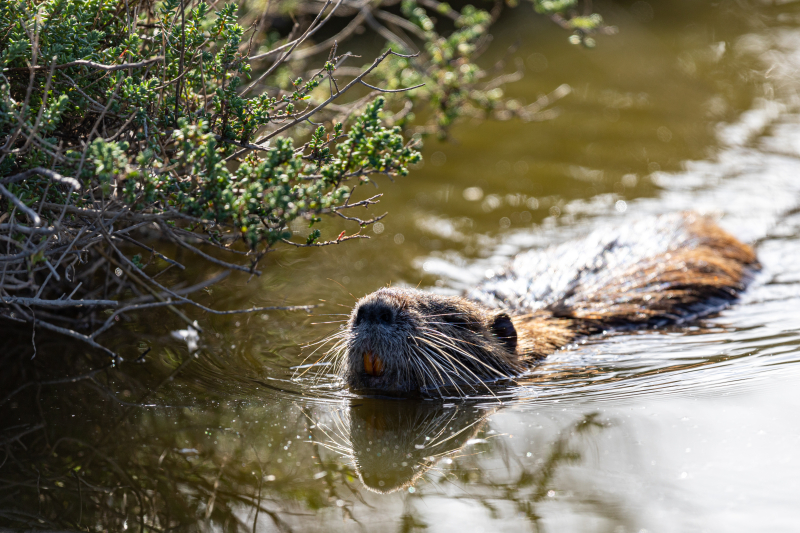
Time to meet our stars on land and in the sky. The beaver is the second-biggest rodent on the planet (only the capybara is bigger). Beavers are built for water. They have thick brown fur, webbed back feet, and a flat, scaly tail. When a beaver dives, clear eyelids slide over its eyes like built-in swim goggles. Its nose and ears close up tight. It can even carry a branch underwater without swallowing a drop, because its lips seal shut behind its front teeth.
Speaking of teeth... they’re bright orange! That color comes from iron in the enamel, and it makes them tough enough to chew through a tree trunk. Gnawing wears them down, so they never stop growing.
Beavers also build dams, which turn streams into ponds and wetlands full of fish, frogs, and birds. That’s why scientists call them “ecosystem engineers.”
Here is the part that starts sad but then ends happy! From the 1600s until 1890, beavers were trapped for their fur until almost none were left, even here in the Adirondacks. Then, in 1904, New York State bought seven beavers from a World’s Fair in St. Louis and sent them home to the mountains. Seven! By 1915, there were about 15,000 beavers in the state. Today, they are thriving. Such a great comeback story, right?
Why "Beaver Moon"?
Full Moons have nicknames, and the one for November is the Beaver Moon. The names come from a mix of Native American and European traditions and folklore, and nobody knows for sure which one started it. Let’s talk about it:
Clue #1: November is prep time for beavers. Winter is coming, so they patch up their dams and stack up a big pile of branches to eat later. It’s like grocery shopping before a winter storm.
Clue #2: This is also when beaver fur gets extra thick for the cold. Long ago, that’s when people trapped beavers to make warm clothing.
Therefore, the name might honor busy beavers, or the season when people were out looking for them.
How do their homes work?
Beaver homes are cleverer than you’d think. Let’s start with a surprise: beavers don’t actually live in the dam!
The dam’s job is to hold back water and make a deep pond so that bears and other land animals can’t wade in and grab a beaver for dinner.
Smack in the middle of the pond, the beaver builds its real home, called a lodge. It’s a dome of sticks and mud, like a little island. Inside, it’s dry and cozy. That’s where the family sleeps, raises the babies, and keeps its food pile.
The best trick is the door. The lodge has entrances under the water, so a beaver can slip in and out without anyone seeing and escape fast if there’s trouble.
- The beaver picks a spot on a narrow part of a stream.
- It stands on its back legs and gnaws through a tree trunk with those orange teeth.
- It chomps the branches and drags or floats the tree to the spot.
- It stacks the wood like a wall, then packs in stones and mud until the water can’t leak through.
Why can beavers stay in the Adirondacks all winter? They don’t hibernate. When the pond freezes over, they swim around under the ice and come home to the lodge. Their food pile is waiting inside.
You also have to know that the dams help us, too. A beaver pond works like a giant sponge. It slows down the water, which can help protect towns downstream from floods and give the land more water to hold on to in a dry spell. Wetlands also store a lot of carbon, up to five times more than dry land. Therefore, the beaver is a flood fighter and a climate helper!

Where to watch the supermoon?
SAVE THE DATE: The Beaver Moon is officially full-on Tuesday, November 24, and the peak time is 9:53 a.m. Eastern. Best viewing nights also include the evenings of November 23rd and 24th, around the moonrise.
The plan is to find a spot with a big, open view and wait until the Moon pops up. A few recommendations from your ADK taste friends include:
- Heart Lake, near Lake Placid. The Beaver Moon will be rising over the High Peaks.
- Cascade Mountain Trailhead. Imagine going on a beautiful, wonderful hike in the Adirondacks to see the Beaver Moon... sounds like the perfect plan, right?
- Blue Mountain Lake. The peaceful water makes it a great spot for just sitting and staring at the Moon. You should check this out.
- Paul Smith’s VIC. Perfect for a night walk under the full Moon in the northern Adirondacks.
Don’t forget your warm hat. It’s November in the North Country!
Sources:
Beaver Trust. (2026, September 3). Beavers - Beaver Trust. https://beavertrust.org/beaver-basics/
Beavers. (n.d.). World Wild Life. https://www.worldwildlife.org/species/beaver/
Beavers - History of the beaver in the Adirondack Park - Hamilton College. (n.d.). https://courses.hamilton.edu/beavers/history-of-the-beaver-in-the-adiro…
Beavers - What is the beaver - Hamilton College. (n.d.). https://courses.hamilton.edu/beavers/what-is-the-beaver
dfg.webmaster@alaska.gov. (n.d.). Beaver Species Profile, Alaska Department of Fish and Game. https://www.adfg.alaska.gov/index.cfm?adfg=beaver.printerfriendly
Full Moon | November | Things to do in the Adirondacks. (2024, November 18). ADK Taste - the Best of the Adirondacks. https://www.adktaste.com/blog/beaver-supermoon-full-moon-november-2024-…
Ridgeway, B. (2024, November 12). You “Woodn’t” Want to Miss the Beaver Moon, Last Supermoon of 2024 - NASA. NASA. https://www.nasa.gov/blogs/watch-the-skies/2024/11/12/you-woodnt-want-t…
Sumangal, B. (2026, June 19). Why do Beavers Build Dams? Pitara Kids Network. https://www.pitara.com/science-for-kids/5ws-and-h/why-do-beavers-build-…
Vogel, T., Vogel, T., Barry, C., & Nguyen, V. (2026, February 12). Supermoons - NASA Science. NASA Science. https://science.nasa.gov/moon/supermoons/

Jimena Galeano is a digital media intern for Nature Up North. She is originally from Guatemala City, Guatemala, and currently majors in data science at St. Lawrence University. In her free time, she enjoys camping, canoeing, and rock climbing.