
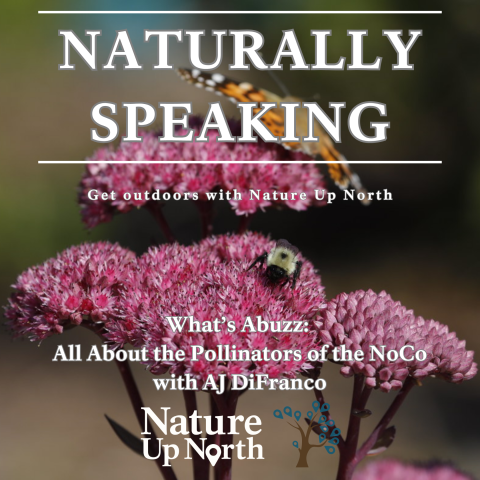
In this podcast, join Digital Media Intern AJ DiFranco as he speaks with local farmer Kia Beth-Bennett of the Bittersweet-Milkweed Collaborative Farm and master horticulturist Erica LaFountain from the Cornell Cooperative Extension of St. Lawrence County. Learn more about the hidden world of pollinators living in the North Country, the threats facing them, and the things we can do to help make the North Country a more welcoming place for our pollinators.
00:00:02 AJ DiFranco
Hello everyone, and welcome back to another episode of Naturally Speaking. I am your host, AJ DiFranco. Today I'm joined by Kia Beth Bennett from the Bittersweet Milkweed Collaborative Farm and Erica LaFountain from the Cornell Cooperative Extension of St. Lawrence to talk about pollinators. Pollinators have such complex roles in their environments and human agriculture, so I'm excited to talk about them today. Starting with Kia Beth Bennett, thank you so much for coming today. First off, why don't you tell us a little bit about yourself and what you do at the Bittersweet Milkweed Collaborative?
00:00:32 Kia Beth Bennet
Yeah, so I am the manager of the Bittersweet Milkweed Collaborative, which is a, oh, I guess you could call it a two-farm farm operation at this point. In 99, my family and I moved to Du Boisster, New York, which is about 1/2 an hour from St. Lawrence University. And my parents began a small, organic, diversified operation. In 2016, after I graduated from college, I began a small, organic potato operation, focusing on growing seeds and food in a manner that really restored the ecology of the land I was working with. In 23, my parents and I transferred the farm over to my name, transferred their farm. And since my potatoes were already growing on what was technically their plots of land, we just smashed everything together. And now I'm managing the whole operation. So it's 113 acres. There are pigs, sheep, chickens, cows, gardens, greenhouses, still doing the potatoes, doing some seed keeping, and really prioritizing that ecological well-being. My agricultural passions are pigs and potatoes, but my personal passions are restoration ecology and endangered species. And I am determined to figure out how in St. Lawrence County, New York, you know, on land that has long agricultural traditions, we can restore the ecology of places that have been absolutely destroyed by some of those agricultural traditions. How can we incorporate ancient techniques of farming with modern techniques of farming, combining native and non-native agricultural species to the land and the human communities who work with that land?
00:02:40 AJ DiFranco
Thank you so much for telling us more about the Bittersweet Milkweed Collaborative. Getting into a little bit about pollinators specifically, what would you say like the diversity of pollinators that you found on your farm would be like? Usually when people think of pollinators, they think of...honeybees and butterflies, but in your experience working at the farm, would you say that you think that there are other pollinators that you rely on that deserve more recognition for the importance that they have in your ecosystem?
00:03:10 Kia Beth Bennett
Yes, so I always wind up having these like sort of niche interests, and insects are one of them, which in my field of work, it's not really niche, but it certainly isn't something I talk about with all of my friends. Not everyone's interested in the creepy crawlies. But because of this, and because of my absolute adoration of identification books, I have maybe a greater knowledge of the different pollinator species on my farm than other farm operations, not to downplay any other farm operations that are doing similar work. This just happens to be one of my small obsessions, that's all. So I'm prioritizing getting to know the syrphid flies instead of something else. I cannot tell you exactly how many or which species in total are on the 113 acres of farm. If you want some real detail on the scientific names of some of those species, someone has to talk to Professor Aswini Pai because she's done studies on our pollinators on the farm. However, we have a lot. I will start right off, we do have wild swarms of European honeybees, Apis mellifera. We have been working with a local apiary that actually gets their honeybees specifically by collecting wild swarms and then bringing them to the hive so that they're not participating in the industry of buying and selling queens or shipping bees across the country. And so that was really cool last year to watch them put up a swarm box and have two sets of bees go to the swarm box.
And so they got two hives out of my backyard.
00:05:13 AJ DiFranco
Yeah, I'm just to kind of quickly interrupt here, since you make it sound like the participating in the act of collecting wild queens and the honeybee market, I guess, so to speak, sounds like it'd be a negative thing. Do you think that there are negatives in perpetuating that, especially since it's considered an invasive species, even though a lot of people think that it does nothing but good for the environment?
00:05:39 Kia Beth Bennett
Yeah, so, and this is a conversation that I feel like I've tried to get into with some beekeepers, and I feel like there was a disconnect there. Like as an ecologist, I'm looking at it from one direction and beekeepers are looking at it from a different direction normally.
00:05:59 Kia Beth Bennett
BM Dooney Farms, which is the local apiary that collects wild swarms, looks at it, I think, much more similarly to me. So the way I see it is because honeybees don't just pollinate, they produce honey. And for the record, honeybees are not the only bees that produce honey, but they are the ones that humans have had this really intensive relationship with for millennia, or they're one of the primary ones, I should say. Because of that, we have been able to commercialize honeybees. And the minute you start to commercialize something is the minute you start to control it. And once you start to control it, and it depends on capital and finances, I think that the quality of life for everyone involved goes down.
00:06:48 Kia Beth Bennett
So yes, I think that small-scale beekeepers, trying to get honey are an important part of the local food system. And I think that the large industrial scale honeybee movements, honeybee selling, you know, you are raising queens in labs and then shipping them across the country to apiaries that have1000 hives that they load on the truck and they drive thousands of miles back and forth so that they can hit the peach blossom time in Georgia and then the blueberry blossom time in Maine.
00:07:29 Kia Beth Bennett
I am not a beekeeper, but from what I understand, that's incredibly stressful on the bees. There's a lot of risk in that transportation, and it means that there is financial incentive to prioritize honeybees as pollinators over protecting the native species who might have already been doing the job or already been doing it better.
00:07:56 Kia Beth Bennett
From what I understand, honeybees are a much more aggressive species than most of our native ones, and they tend to push out the native species when given the opportunity, which further complicates the cycle, because if the honeybees are pushing the native species out, then you're going to need to keep importing more honeybees to continue the pollination. If you drop the honeybees all of a sudden it's going to take a few years for the native species to bounce back to the extent that you would feel satisfied with the pollination.
00:08:29 Kia Beth Bennett
Or if you're a conventional operation and you're using enormous amounts of pesticides that maybe the honeybees can withstand for longer, I promise you that the native species are not pollinating your fruit the same way. So again, it's going to take longer, so small scale beekeeping, I'm a big fan of having locally produced sweets like honey and maple syrup. And I think that that's an important part of the food system. But yeah, the industry, the industrial part I have a serious problem with.
00:09:02 AJ DiFranco
Thank you so much for speaking on that, and I guess getting back to the thing we were talking about before.
00:09:07 Kia Beth Bennett
Yeah, I can talk about natives too.
00:09:10 AJ DiFranco
Like tell us more about like some of the native pollinators that you see, like we don't need like an itemized list.
00:09:16 Kia Beth Bennett
Okay, but I brought an itemized list. So our farm has the benefit of being seriously diverse, not just in the actual practices that we use, because we do plant flowers and herbs and vegetables and fruit. And so we know that adds diversity, but we also are being 113 acres, we're home to a lot of micro ecosystems.
00:09:41 Kia Beth Bennett
There are ponds, there are forests, there are streams, there are wetlands, there are fields and pastures and small gardens, there's fruit forests, there's hedgerows. And so that diversity of ecosystems also makes it easier for a wide variety of native pollinators to live on the farm.
00:10:03 Kia Beth Bennett
We have, okay, I know you said I don't need to do an itemized list, but I'm gonna just, I'll talk about some of my favorites.
00:10:09 AJ DiFranco
If you have an itemized list, please go for it.
00:10:11 Kia Beth Bennett
Really? Okay, Keep in mind, I don't know the scientific names for most of these, but:
00:10:19 Kia Beth Bennett
bottleflies, carpenter bees, mason bees, tricolored bumblebees, common eastern bumblebees, dark paper wasps, pandora sphinx moths, green sweat bees, syrphid flies, goldenrod soldier beetles, monarch viceroy, monarch and viceroy butterflies, bee flies, black swallowtail butterflies, tiger swallowtail butterflies, great swallowtail butterflies, leafcutter bees, ligated furrow bees, white lime sphinx moths, mason wasps. We have bald-faced hornets, eastern yellow jackets, common aerial yellow jackets, eastern hornet flies, milquet tussock moss, virginia tiger moss, red admirals, silver-winged skippers, varieties of rusty-colored skippers. I don't know all of them. Painted ladies, luna moss, polyphemus moss, hummingbirds, which I know some people argue may or may not be effective pollinators, fritillary butterflies, question mark butterflies, checkered white butterflies.
00:11:16 Kia Beth Bennett
Gosh, that's a lot smaller than it was when I was writing it down, and I'm sure that we have more than that. The list I just read focused a lot on bees and butterflies, and so they are, of course, incredibly important to the farm. But I am a big fan of the ways in which beetles flies and wasps also do a lot of pollinating, but they're severely underappreciated.
00:11:45 Kia Beth Bennett
Even when we talk about native pollinators, people go, okay, well, what about native bees? So I think the public perception of a native bee is, oh, they're kind of like a honeybee, but different, and they really are just so different, which is where the diversity of the ecosystems comes into play, and the diversity of foodstuffs comes into play.
00:12:10 Kia Beth Bennett
A lot of the native bees are solitary creatures. A lot of our native wasps sting, and so people don't want them around. A lot of our native beetles do pollinate, but people don't even know it. So when we've got open soil that's high in organic matter, and it's crumbly, and it's easy for the bees to go underground, that creates another habitat, and so there's specific parts of my garden that are open soil with high organic matter and crumbly, and it's easy for the bees to go underground.
00:12:46 Kia Beth Bennett
We've got a lot of garden spaces that we don't clean out for the winter, right? We've got sunchokes, we've got reed canary grass, which yes, is a non-native species. We've got angelica.
00:13:01 Kia Beth Bennett
All of these have hollow stems or pithy stems that the bees can hibernate in or they can lay their eggs in. You know, the mason bees come in and in the cement walls of one of our greenhouses, they lay their eggs in the holes, the air bubbles of the cement walls.
00:13:19 Kia Beth Bennett
I've had to sacrifice several surge bars and, keep in mind, I understand surge bars are plastic. This is not ecologically like prime, but mason bees really love laying their eggs in functioning surge protectors. I don't understand why, but I've sacrificed a lot of electricity, like electrical units for mason bees.
00:13:47 Kia Beth Bennett
And we have such like such diversity of plant matter. When I think about the shrubland that I was talking about earlier where the cattle are, the cattle are coming through and they're pruning the black cherry trees. So the black cherry trees are healthier.
00:14:05 Kia Beth Bennett
Well, the black cherry trees have crevices in their bark. So those are a great place for butterflies to hibernate in the winter. They have early blossoms in the spring, so they're good for early pollinators coming out who need food. And their leaves are a source of food. They're a host plant for a lot of caterpillars who will then turn into butterflies or moths and become pollinators.
00:14:30 AJ DiFranco
Thank you so much, Kia, for sharing so much information about all the different species of pollinators. I'll be sure to keep my eye out for some next time I'm outdoors.
00:14:37 AJ DiFranco
Next up, we're now going to talk with Erica LaFountain about some of the threats facing pollinators and what we can do to help them. Thank you so much for joining us, Erica. Would you mind introducing yourself?
00:14:47
Hello, everyone. My name is Erica, and I am the community horticulture educator and master gardener volunteer coordinator over at Cornell Cooperative Extension in St. Lawrence County.
00:15:01 AJ DiFranco
So right off the bat, would you mind telling us a little bit about what the Cornell Cooperative Extension is and what you guys do in Canton?
00:15:09 Erica LaFountain
So we are part of a system of county associations that are all connected to Cornell University, and each of our associations in the counties are tailored to the local population so that we can serve the people of that county with research from Cornell University as well as local experience, our county specifically. And so all of our educators deliver that kind of a service and also our volunteers like the Master Gardener volunteers.
00:15:49 AJ DiFranco
Thank you. That sounds really cool. So would you mind telling us, also telling us a little bit about what exactly it is that you do at the Cooperative Extension?
00:16:00 Erica LaFountain
Yeah, so as community horticulture educator, I deliver programming to the public about gardening, and I also provide one-on-one support to gardeners in the county, and I also provide articles mostly through our blog called the Fruition Blog, which is all about local food and gardening and farming.
00:16:24 Erica LaFountain
I also coordinate the Master Gardener volunteers who do all of those same things I do so that we can reach the whole county because we can accomplish so much more with those couple dozen really active volunteers than I can do alone.
00:16:38 AJ DiFranco
So the topic of our podcast today is pollinators, and so we're going to be talking about the pollinators that can be found up in the North Country, and obviously pollinators are important because they pollinate the plants that live up here. It's important as a master gardener and anyone involved in agriculture.
00:16:58 AJ DiFranco
So my first question for my first question about pollinators for you, so when most people think about pollinators, they usually think about honeybees and bumblebees, and that's usually kind of it, maybe butterflies. Are those the only pollinators found in the North Country? What are your thoughts on honeybees? And do you think there are any other pollinators up here that deserve recognition beyond honeybees?
00:17:24 Erica LaFountain
So bees are the main pollinator, but there are so many different kinds of them, and honeybees are non-native. There are about 450 different kinds of native bees in just in New York State. There are about 4,000 different species of wild bees in the country. And so thinking about honeybees, they're really outliers when it comes to pollinators because they're not from here, you could think of them more like livestock because they're managed by humans.
00:18:06 Erica LaFountain
They make a real contribution to the economy, both because of honey production and because of pollination, and they're moved around and very heavily managed by humans, although some of them are also naturalized into the environment.nYou can find populations that are not managed by humans, but they're still genetically not from here.
00:18:32 Erica LaFountain
But those 450 other species also provide real ecosystem services that have a lot of value for us agriculturally, but also because they pollinate all of our native flowering plants, and so without them, those plants wouldn't exist, and they're really the underpinnings of our whole local ecosystem, those plants are.
00:19:01 Erica LaFountain
70% of those wild bees are solitary bees. Most of them nest in the ground. So if you're imagining these big colonies of social insects, most of our wild bees are nothing like that. 30% of them actually nest in hollow stems as well. And according to the Empire State Native Pollinator Survey, a lot of those species, those 450 different bee species, are at risk. And many of them actually haven't been seen in the last few surveys they've done of wild native bees.
00:19:51 AJ DiFranco
So, building off on that point, when you say that a lot of these bees are becoming more rare, what would you say that some of the biggest risks, maybe not risk is the best word, what are some of the biggest threats that are being posed to these native bee species? Why are they becoming rare?
00:20:11 Erica LaFountain
Well, I would say the main reason is habitat loss. And when you look outside, you can tell that just the built environment of humans is taking up a lot of space these days, and even outside of the built environment, we have heavily managed rural lands, places where there's constant haying. So, or agriculture.
00:20:43 Erica LaFountain
And so wild flowers are just becoming more rare in the landscape. Another big one is climate change. That's having a real effect in many different ways, but some are, some of those ways include more extreme weather events, more droughts, more extreme rains, things like that affect these pollinators.
00:21:08 Erica LaFountain
And then also, what was I going to say? Also, there can be a misalignment between when the native plants bloom and when those pollinators are out because of just the natural conditions changing. And that can cause problems where plants don't get pollinated and where those pollinators aren't getting the resources they need from the plants they've always depended on.
00:21:53 AJ DiFranco
That sounds awful. And I guess building on that further, would you say, as a master gardener, would you say that bees, do you rely on these bees for like these native bees, not just the honeybees and stuff, for like gardening and stuff? Or is it just like the random little flowers that people are like, yeah, we can live without them?
00:22:24 Erica LaFountain
That's a great question. We actually depend on pollinators generally for one out of every three bites of food that humans eat. So loads of our agricultural crops, I think 1,200 different crops require insect pollination. The honeybees, because of the way they're managed, actually do provide a really huge amount of that, but wild native bees also provide, I read just in New York State, $300 million worth of ecosystem services by pollinating crops.
00:23:11 Erica LaFountain
And so that's just in New York State, and that includes things like apple trees, berries, squash, a lot of the crops we grow in our gardens, a lot of crops that are grown commercially. And 90% of flowering plants depend on pollinators.
00:23:29 Erica LaFountain
There are some that are pollinated by the wind, things like corn, and certainly some native plants are as well. I mean, native flowers. Corn is sort of a native plant.
00:23:42 Erica LaFountain
But if we think about what the world would be like without those pollinators, we would see precipitous decline in flowering native plants, we would also have to find a different way to pollinate our agricultural crops. And when there's a decline in those native plants, we would see a decline in other insects that depend on those plants. All of the so many butterflies and moths whose caterpillars feed on those plants. And then that would cause then a decline in all the things that depend on those insects and those caterpillars.
00:24:28 Erica LaFountain
So songbirds, amphibians, reptiles, other mammals, other insects, you can imagine how pretty quickly that whole ecosystem would fall apart. And so we might not really realize that we're depending on all of that being stable. We kind of take it for granted, but the whole thing could pretty quickly collapse if we didn't have the small kind of unseen services of these creatures.
00:24:56 AJ DiFranco
Yeah, it's like taking out the wrong Jenga block.
00:25:00 Erica LaFountain
Exactly. And it's not just the bees, although they do a huge amount of this pollinating, but also flies and beetles, and we mentioned butterflies, but even moths also can be big pollinators. So yeah, it's a lot of other insects as well.
00:25:21 AJ DiFranco
So moving on, so definitely seems like a pretty dire situation that a lot of our pollinators are facing up here with the combined threats of climate change and habitat loss in the North Country. So with kind of going from that, what are some ways that you would suggest that the average listener to this podcast could maybe help alleviate some of those threats facing pollinators?
00:25:55 Erica LaFountain
So some of the things we can do, especially for people who manage some amount of land, who have property and make decisions about what's done on that property, one of the things you can do is to plant native plants there to support pollinators and to support really the whole local ecosystem that I was mentioning.
00:26:19 Erica LaFountain
Ideally, if you're planting native plants, you would be choosing ones that have blooms that come out throughout the season. So from early spring into really late summer and even early fall, as opposed to just one type that only you would only see blooms in one part of the summer, for example.
00:26:41 Erica LaFountain
And also there's this concept of keystone species. These are plants. They could be shrubs, herbaceous plants, trees, that support a really outsized number of insects, including pollinators. And so it's fun to do a little research on the keystone species for the area you live in.
00:27:06 Erica LaFountain
And there's a website I really recommend called NativePlantFinder.nwf.org. It's a place where you can put in your zip code and find out the keystone species for your particular place. And so, for example, some of the trees that support the most, and these are actually, I should mention specifically, they support the most butterflies and moths in their different forms.
00:27:39 Erica LaFountain
Oak trees, also cherry trees, goldenrod is an herbaceous plant, wild strawberries.
00:27:46 Erica LaFountain
So if you want to have like the most bang for your buck as far as a native planting, looking up keystone species and using that website to find out which ones will have the most impact is a great thing to do.
00:28:01 Erica LaFountain
Also for property owners, leaving some wild areas on your land, places where there's decaying wood, wood mulch, undisturbed ground for all of these ground nesting bees, which I mentioned 70% of our wild bees nest underground, so they need undisturbed ground to create those nests.
00:28:25 Erica LaFountain
Also leaving out water, something like a bird bath can help those bees, which all need water. And another thing is leaving your leaves where they are or raking them into garden beds in the fall rather than getting rid of them because a lot of insects actually depend on those leaves and some are nesting inside of them. And so keeping them on your property is a great way to support insects. And just generally becoming more of like a messy garden owner is really great for insects.
00:29:03 Erica LaFountain
Another one is mowing high so that when you're mowing your lawn, if you're mowing at least like 3 to 4 inches instead of really tight to the ground like a golf course, that's a great way to allow some of the really low flowering plants like clover to bloom, which insects like pollinators really can get some great nectar and pollen from
00:29:33 Erica LaFountain
There are also lots of opportunities to learn more. Even if you rent an apartment and don't have any control over the property where you are, you can still learn about native plants and encourage your municipality to add native plants to public areas.
00:29:52 Erica LaFountain
A great place to start could be getting a free identification, plant identification app like Seek, which is made by iNaturalist, and using an app like that, you can start to identify the plants in the vicinity of places where you work or live and learn which of those are native plants and which have specialist relationships with insects.
00:30:23 Erica LaFountain
I love the books by Doug Tallamy, who was one of the founders, one of the researchers behind the website that I mentioned, the Native Plant Finder website. He has some great books about those insect-plant relationships and how important native plants are. He's an entomologist, and one of his new books is called How Can I Help? Saving Nature with Your Yard and has a lot of great advice for ways to support pollinators and other insects on your property.
00:31:00 AJ DiFranco
Thank you. I definitely really want to try taking a look at that native plant finder website. That's actually news to me. I think it sounds really cool.
00:31:12 Erica LaFountain
One of the, I mentioned oak trees. I believe it was the oak that actually supports 500 plus different kinds of moths and butterflies. So you can see why they would call it a keystone species. Without oaks, there would be so many species that would be struggling.
00:31:30 AJ DiFranco
That's absolutely incredible. Thank you so much for talking about pollinators with us today. It's been really nice seeing, like hearing what you have to share. I guess before we wrap up, do you have anything else you'd like to share?
00:31:48 Erica LaFountain
Yeah, I would like to mention that if anyone out there is feeling inspired and wants to get involved, I mentioned some ways you can do that on your own, but there are also ways you can do that with other people who have common interests.
00:32:04 Erica LaFountain
We have a pollinator garden at the Cornell Cooperative Extension Office in Canton. And we have a series going on this season called Homesteading for Everyone, and one of the events is going to be getting a tour of our pollinator garden. And I encourage you to go to our website to find out about when that's happening later in the summer.
00:32:30 Erica LaFountain
And, in addition to that get together, there's a native plant group in Potsdam that gets together really to support each other in personal but also public municipal efforts to increase the number of native plants on local lands. And it's a great place where people do everything from sharing plants and seeds to sharing book recommendations to just talking about what worked and what didn't on their own properties.
00:33:04 Erica LaFountain
I also encourage people to check out books from their library, and we have actually a new NoCo seed library that our Master Gardener volunteers in the county have put together, and it can be found within the Canton Free Library. And it's a great way to find seeds for garden plants, but also there are some native flowering plants seeds available in there as well, and including some that locals have collected themselves and so they're very locally adapted.
00:33:40 Erica LaFountain
So I encourage you to check that out. It's free to take up to 10 packets from there. And I just encourage everyone to get involved and start becoming part of the solution in whatever way you would like to.
00:33:56 AJ DiFranco
Well, that's it for today. It is really fun to discuss the types of pollinators we can find in the North Country, the threats that they face, and the things that we can do to help make the North Country a better place for them. I want to thank Kia and Erica again for coming out and sharing what they know.
00:34:10 AJ DiFranco
I'm your host, AJ DeFranco, and until next time, get up and get outdoors with Nature Up North.