
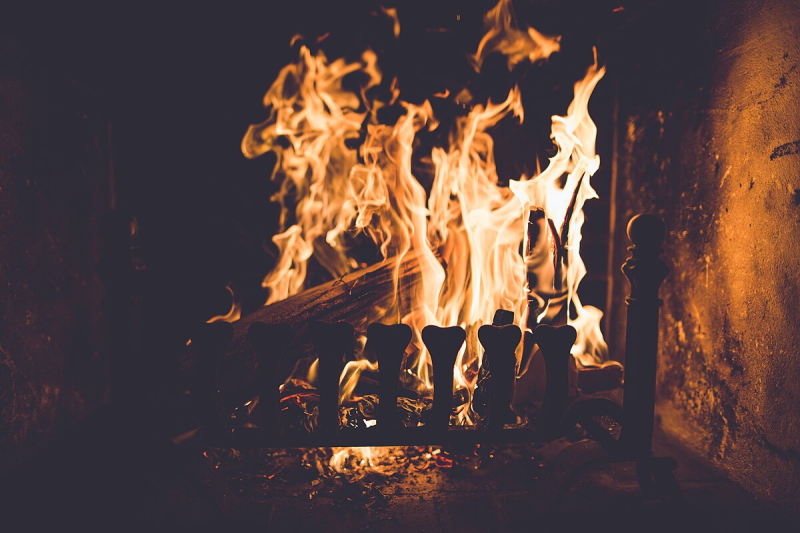
Yule Logs
In most parts of the world, the tradition of burning a Yule log, sometimes called a Christmas log, has largely fizzled out. While holiday cards may show charming birch logs aflame in a hearth, old-time Yule logs in 6th and 7th century Europe looked more like saw-logs. Some of them wouldn’t fit in a house, let alone a fireplace. Because these monster tree trunks were meant to burn all day, and in certain cultures for twelve continuous days, they were typically oak, a dense, hard wood that burns a long time. The catch is that the Yule log was not supposed to be being entirely used up, which is a significant detail.
Apparently, if you didn’t have a leftover bit of the Yule log after the marathon burn was done, you were doomed to misfortune in the upcoming year. And so, remnant pieces of the charred Yule log were often saved to light the following year’s log, squirreled away under beds, or in the rafters or the ceiling. I assume it was extinguished before being tucked in the rafters, or some really bad luck would ensue.
While a birch log is appealing, it doesn’t compare with many other hardwoods in terms of heat value and how long it will burn. Heat value from wood and other fuels is measured in British thermal units or BTUs. The Brits, who claim to have espoused the metric system since the ’60s, still cling to this elegant way of measuring heat – a BTU is the energy required to heat a pound of water one degree Fahrenheit.
When you look at firewood BTU-value charts you’ll see that few of them agree exactly. This is to be expected, as the heat value of a given species varies according to the conditions in which it grew.
In this region, fuel wood is usually hardwood. Of course, that’s a misnomer, as some “hardwoods” are softer than “softwoods” or conifers. Eastern cottonwood, for example, has a rating of around 12 million BTUs (mBTUs) per full dry cord, lower than that of white pine, which is rated at 16 mBTUs. Remember that a full cord of wood is 128 cubic feet; usually 4 feet high x 8 feet long x 4 feet deep, while a typical face cord is 16 inches wide x 4 feet high x 8 feet long.
As those who heat with wood know, hickory and hard maple are tops among native species, producing close to 29 mBTU per full cord. You’d have to burn twice as much butternut to get the same amount of heat. American beech, white oak and ironwood (hop hornbeam) also rate quite high, around 25 mBTU/ full cord. The iconic paper birch has about 20 mBTU, respectable but not a premium fuel.
There are other considerations aside from BTU value in choosing firewood. Even though balsam fir heats better than butternut, it throws a lot of sparks, creating a potential hazard in an open-hearth fireplace.
Moisture is also critical. When green wood is burned, much of the wood’s heat value goes into boiling off the water, not to mention that it leads to heavy creosote buildup. Black locust and apple, two non-native species which have widely naturalized throughout the province, have BTUs per volume higher than the best native species. But fresh-cut apple is 70% water by weight. Assuming you could even keep it lit, you’d get far less of its potential heat value.
Outdoor furnaces are capable of burning green wood because they have a blower. This might be seen as a convenience, but when unseasoned wood is burned in an outdoor furnace, it generates at minimum twice the carbon dioxide, costs more than two times as much, and takes at least double the time to load the firebox. I don’t know about you, but if I had to choose between lifting six tons of wet wood as compared to three tons of dry wood over the course of a season, it wouldn’t take long to decide.
In the Balkans and parts of southern Europe a genuine Yule-log tradition still burns on. In Québec and other regions as well, a much tastier version is popular – the Yule cake or Bûche de Noël is a time-honored Christmas dessert. The Bûche de Noël is seldom burned, however, and never intentionally.
You can tune in to online or televised Yule Log programs this holiday season. While there are many now, the original has been going since its initial appearance back in 1967. Considering that the first TV Yule log was lit fifty-plus years ago, we could probably solve the world’s energy problems if we determine what species of wood was used and simply plant a few of those trees in our yards. Of course, a lot of secret Cold-War research was conducted in the1960s, so it might be classified.
If you’re one of the few families who will light an old-fashioned Yule log in an open hearth this year, you probably will select a good chunk of a premium hardwood species. Given the information above, I’m sure Yule choose wisely.
Paul Hetzler is an ISA-Certified Arborist and former Cornell Cooperative Extension educator.

Paul Hetzler is the Horticulture and Natural Resources Educator for Cornell Cooperative Extension of St. Lawrence County.