
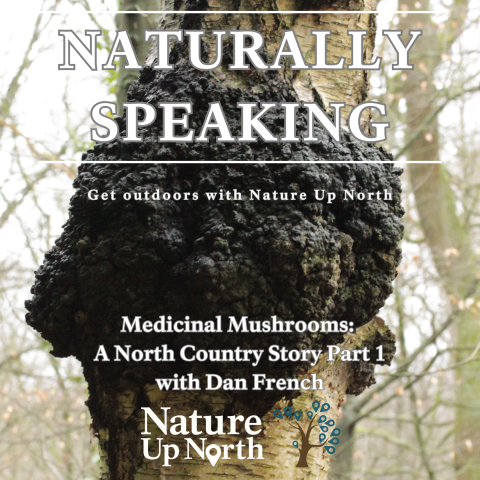
This is part one of a two part podcast with the Vice President of Birch Boys Inc. Kaitlin Lawless. Birch Boys is a local business based in Tupper Lake on the sustainable harvest and manufacture of various mushroom-based medicines. In this part, join Project Manager Dan French as he picks Kaitlin’s brain about how Birch Boys got started, how they picked their selection of mushrooms, and how they’ve sourced their mushrooms in the past and present.
00:00:12 Dan French
Welcome back to another episode of Naturally Speaking. I'll be your host today, Dan French, Project Manager for Nature Up North, and I'm really excited to have Kaitlin Lawless join us in the studio today.
00:00:21 Dan French
Kaitlin Lawless is the vice president for Birch Boys Incorporated, based in Tupper Lake. She's also a North Country native and local mushroom expert.
00:00:29 Dan French
And we'll be talking today about how recent trends in climate and weather have impacted the health of local native mushrooms, and what Birch Boys Incorporated is doing to help alleviate any stress from their harvests when it comes to the sustainable harvest of local mushrooms.
00:00:44 Dan French
Thank you, Kaitlin, so much for joining us today.
00:00:46 Kaitlin Lawless
Thanks for having me.
00:00:48 Dan French
So I wanted to start, and correct me if I'm wrong, Birch Boys Incorporated, you're a business based in Tupper Lake, and you deal with creating tinctures, teas, and skin care from mushrooms sourced from the United States.
00:01:02 Kaitlin Lawless
Absolutely. We focus on tinctures. Those are just really effective kind of medicinal preparations of mushrooms. And then within that, we focus on the species that we can harvest here.
00:01:13 Kaitlin Lawless
Some customers have asked us to open up into some species that aren't really abundant here, and we have obliged in that as well.
00:01:20 Kaitlin Lawless
Awesome. What are tinctures? Because I'm not, this is outside of my personal like skin care health realm. So I'm, what are they?
00:01:27 Kaitlin Lawless
So A tincture is, the like legal definition of a tincture is any kind of dissolved medicine inside of an alcohol preparation.
00:01:36 Kaitlin Lawless
Within that or outside of that, tinctures can vary a lot. So we make double extract tinctures. So it's about 75% a really, really potent tea and then 25% an alcohol extraction. And those different extractions, you know, allow different solutes to become available. So the alcohol extraction is really important for some of the profound compounds you hear about. And then the hot water extraction is great for some of those run-of-the-mill antioxidants, immune health things that come up.
00:02:07 Dan French
Awesome. And so you pull these out of a variety of mushrooms. And for the audience at home, I know Kaitlin and the president, Garrett, from years ago when this all first got started and at that point in time, chaga was the main focus of the business.
00:02:21 Dan French
I know that Garrett had a personal connection to chaga. I'm wondering if you could speak to why chaga might have been the start of it all and why that was such a draw for the business?
00:02:32 Kaitlin Lawless
Absolutely. So Garrett discovered chaga when he was, I believe it was 15. He has always been an entrepreneurial individual. So he was mowing lawns in Tupper Lake, and his grandmother had what he thought was iced tea in her fridge.
00:02:48 Kaitlin Lawless
So he was parched, went and chugged a couple glasses of this iced tea, and she came in and saw him and thought it was hilarious that he was drinking this tea. It turned out to be chaga tea, which is very high in antioxidants, pretty much second only to cloves as far as naturally occurring non-synthesized antioxidants go.
00:03:09 Kaitlin Lawless
So she was using it because she had stage 4 pancreatic cancer. She taught him all about chaga. She just happened to have a birch tree with chaga on it outside of her front door. And then the elderly club of Tupper Lake started having Garrett scale the trees for them to get chaga.
00:03:28 Kaitlin Lawless
And that's where the term Birch Boy comes from. That, and it's catchy. But Garrett became the Birch Boy of Tupper Lake, going up those trees to get all of the elders their chaga.
00:03:39 Dan French
I didn't know it was an elderly project. That's actually pretty funny. Now chaga itself, it's native to the US and other parts of the world as well, is that right?
00:03:47 Kaitlin Lawless
Yep, it's pretty widely distributed. It's really dominant in semi-arctic climates, so you'll see it kind of all around the same latitude in the world. So it's in Siberia, it's in Finland, it's in Canada, and pretty much anywhere where you have that deep, harsh winter.
00:04:06 Dan French
Yeah. And what's its relationship to birch trees?
00:04:09 Kaitlin Lawless
So it is a parasite to birch trees, and this can be controversial in some circles. Some people really want to believe that chaga is symbiotic with the birch tree. That is unfortunately just straight up not true.
00:04:20 Kaitlin Lawless
However, you don't have to be too sad about it because birch pretty much everywhere are like pioneer species. They don't have a super long lifespan anyway. So people are like, oh, but the birch tree, it's going to die. The birch tree was going to die anyway.
00:04:35 Kaitlin Lawless
So yeah, chaga essentially penetrates through a wound in the birch tree, colonizes really slowly the heartwood of that tree, eventually bursts out the side of it. That usually takes about two or four years to even see the conk of chaga visible. And then depending on the size of the birch tree, it can either kind of stop there, reproduce, and fall off, the chaga goes bad and the birch tree dies, or it can host itself there for upwards of 20 years even, just kind of absorbing beneficial compounds the whole time.
00:05:07 Kaitlin Lawless
And one of the reasons that the Adirondacks and the North Country is so ideal is because we have a large species of birch tree here called Betula alleghaniensis. It's a lot bigger than the birch trees that will occur in other places in the world. And chaga can grow for a lot longer on the birch tree, the golden birch tree, because it has so much more heartwood in it.
00:05:28 Dan French
Wow, okay. We'll get into all that and how you harvest it and all that later, but I wanted to, before we get too deep into the science, I wanted to talk about you as well, since you're the vice president. The founding of Birch Boys seems pretty personal to Garrett and I'm wondering how you got involved and became the vice president.
00:05:45 Kaitlin Lawless
Absolutely. So Garrett and I met at 4-H Camp Overlook when we were 11 and became pretty fast friends. We met up each time we went to 4-H camp ever after that. We both became counselors. And essentially, Garrett and I, Garrett was in his second year of college while I was starting my first, and we had a ragtag group of students from SUNY Potsdam and Clarkson that were kind of running the business and basically I left college to do brand management for Birch Boys that first year.
00:06:22 Kaitlin Lawless
I did decide I wanted to broaden my horizons and move to Massachusetts for a few years. And COVID hit, so it meant my foray in Massachusetts was not great. Couldn't learn, couldn't do anything, couldn't get to know the area, nothing. So eventually I worked at an upscale pet store learning a lot about nutrition for about three years there. And Garrett reached back out and asked if I would be interested in coming back on as a remote employee.
00:06:50 Kaitlin Lawless
So I said yes. Then I ended up moving home because why wouldn't you move home? The Berkshires do not compare to the Adirondacks. Don't fight me. They're beautiful, but it wasn't home.
00:07:02 Kaitlin Lawless
So I came back and now I actually live in Potsdam and I work remotely for Birch Boys, but I do go into Tupper quite often. So I started out when I had come back just as a sales associate, but pretty rapidly moved up because I'm pretty involved and I really like the subject matter.
00:07:18 Dan French
Yeah. I don't think you'll have any problem with the listeners of this podcast preferring the Adirondacks to the Berkshires. But Birch Boys is a team of four now. So it's you two and then two others?
00:07:29 Kaitlin Lawless
So we're actually a team of six. It's Garrett, myself, our production manager, Trish, my assistant, Penny, our production manager, Richard, and his assistant, Kyle.
00:07:39 Dan French
And are they all based locally or are they spread out?
00:07:42 Kaitlin Lawless
Everyone except for my assistant, Penny, is based locally, and then Penny's actually out of Colorado.
00:07:48 Dan French
Sweet.
00:07:49 Dan French
Does the business now deals with six or seven different varieties of mushroom. I think I noted them down here.
00:07:58 Dan French
So we have chaga, lion's mane, cordyceps, turkey tail, reishi, maitake, maitake.
00:08:05 Kaitlin Lawless
Maitake.
00:08:06 Dan French
Maitake, thank you, and artist's conch. Why expand from chaga? If you can answer that question.
00:08:12 Kaitlin Lawless
That is a funny question, and I'm actually going to throw back to Garrett and I did a little podcast-esque thing for our customers the first year I had returned to Birch Boys, and I asked him that question.
00:08:25 Kaitlin Lawless
And his answer was, Kaitlin, you told me to expand into the mushrooms beyond chaga the first time that you worked here, and right before you, right after I had left was when he started up the reishi tincture.
00:08:37 Kaitlin Lawless
So I had gotten really into making graphic design is a hobby and thing I do for the business. So I had gotten really into making, charts and different infographics about the mushrooms and had focused on chaga, reishi, turkey tail, and a few other ones that were just kind of popular in fungi culture at the time.
00:08:58 Kaitlin Lawless
So it was funny coming back and having, you know, a whole bunch more species to deal with. And what I will say is I definitely focus more on mushrooms, whereas Garrett is definitely more focused on chaga.
00:09:11 Kaitlin Lawless
And chaga is a different part of the fungal organism. It's not technically a mushroom, but most people know it as a mushroom so totally okay.
00:09:19 Dan French
Could you explain the difference? Because when we were initially emailing, I think I put in an e-mail that I had read on your website that it wasn't the mushroom. And then as I was emailing later, I'm like, but it feels like it's referred to as that. And I was, what's the distinction?
00:09:32 Kaitlin Lawless
So basically a mushroom is a reproductive kind of fleshy spore bearing structure, usually very moist. Chaga is actually a sterile structure. It's a different part of the fungus. So it's not reproductive instead, it's a defensive organism.
00:09:48 Kaitlin Lawless
So it actually concentrates all of the immune compounds that the birch tree is sending at the chaga fungus to try to dispel it, concentrates all of those into this conch to use as its own defense mechanism back against the birch tree. And so that's why it's such a potent source of medicine is because all of these birch compounds that are very good and immune stimulating concentrate themselves in this so the chaga can fight it off.
00:10:14 Kaitlin Lawless
So chaga has a different reproductive structure. It's called a poroid. And so once chaga is finished colonizing the birch tree, it actually rips open the bark of the birch tree and reveals like a sticky gray layer. That's the spore containing material.
00:10:30 Kaitlin Lawless
Bugs have a symbiotic process with this and they distribute it out to all of the other birch trees.
00:10:37 Dan French
Is that akin to pollinating in a way, or is that a poor description for what those bugs are doing?
00:10:43 Kaitlin Lawless
I mean, yeah, you could look at it like pollinating. A lot of fungi have kind of interdependent relationships with bugs carrying spores, but things like reishi, the spores are very dry, as long as they aren't, it's not raining. So the wind will actually pick up those spores.
00:11:00 Kaitlin Lawless
But whereas with chaga's spores, they're kind of gooey. They're kind of a sticky material. And so these bugs eat them and then go poop them out.
00:11:05 Dan French
Okay, so that’s..
00:11:10 Kaitlin Lawless
That's my highly technical lingo for it.
00:11:14 Dan French
So it sounds like chaga in particular, you mentioned earlier, has a parasitic relationship with the birch tree. And so when I'm looking at Birch Boys Incorporated, it appears to me like you're almost farmers collecting a crop from the forest. But when I think of farming, I think of people going out and planting their seed and cultivating it and harvesting it. But that's not quite what's going on here.
00:11:34 Dan French
So I'm wondering how you manage to maintain your supply of these mushrooms when it takes four years for these things to even get started in a new tree, which seems like a pretty long-term investment if you're planning on that part, at least being what supplies you.
00:11:51 Dan French
So I'm, to phrase that in a better way, I'm curious how you look at harvesting these mushrooms in a way that's going to continue the supply for the business in the future and how that looks.
00:12:01 Kaitlin Lawless
Absolutely. That's actually a huge focus of ours. And it's one of the things about our business that makes us pretty unique in the industry. Basically, there's so much to get into with this question that it's just like, there's a world of possibilities of realms for me to go down with this.
00:12:20 Kaitlin Lawless
But, you can make what Garrett and I like to call fake chaga. That is the mycelium of chaga grown on grain. There's no actual conk of chaga, like the medicinal part, because chaga is a parasite. You can't have a parasitic growth off of like non-living grain.
00:12:39 Kaitlin Lawless
So what some companies will do is they will have myceliated grain mixed in all these threads of mycelium in their grain spawn, and they will tincture that and they'll sell that.
00:12:51 Kaitlin Lawless
The problem with that is that that's about 70% grain and about 30% mycelial threads. And if you actually take the conch of chaga and compare its bioactive compounds to what's in the mycelial threads, the conch is better to begin with.
00:13:05 Kaitlin Lawless
So that's a way that a lot of brands will get around the sustainability issue. We are very lucky here. Our ability to be sustainable is very tied up with the golden birch tree that I mentioned earlier. And that's because chaga can sometimes colonize just a limb of that golden birch tree, destroy that limb, limb falls off, the rest of the tree continues to grow. Maybe chaga pops up on another limb.
00:13:28 Kaitlin Lawless
Some of these golden birch trees are upwards of 200 years old. So the dense, chaga is very dense. It's like the most hard, non-mineral substance. So you can't, like, people will try to eat it. You will hurt your teeth. It will mess with your GI tract. You don't eat raw chaga. You make things out of it.
00:13:50 Kaitlin Lawless
So basically we have an eight-point sustainability plan with chaga. So the first point is sourcing out of the Adirondack Park because we have access to the golden birch tree, which is essential for our business.
00:14:01 Kaitlin Lawless
The next is scouting. We're going to scout out the land, assess how many poroids and birch trees and the kind of birch tree and chaga growths are there.
00:14:08 Kaitlin Lawless
The next is long-term planning, so we have access to this land in order to keep an eye on it, decide what we're going to do for the next year, et cetera.
00:14:16 Kaitlin Lawless
We also only work with expert harvesters. So people who are loggers and are really familiar with this subject matter, DEC license guides, nature enthusiasts who we've worked with for a long time. I think at this point, we only have about 8 harvesters who we work with really closely.
00:14:32 Kaitlin Lawless
The next is timely harvest. With chaga you don't want to harvest it off the ground. You want to harvest it while it's still on the tree.
00:14:40 Kaitlin Lawless
The next is waste management. So we essentially require that all of our chaga is brought in, all of our mushrooms are brought in within 24 hours of harvest and they have to be stored very appropriately before that.
00:14:52 Kaitlin Lawless
And the next is emergency preparedness. We are working on being able to inoculate birch trees with chaga in the event that it ever becomes threatened. But on the International Fungal Red List, it's currently considered a species of least concern.
00:15:06 Kaitlin Lawless
And the last is nature's consent. People up here understand that you get a vibe in the forest and you don't want to take things that don't feel right to take. So we always check in with Mother Nature before we take things from the forest.
00:15:20 Kaitlin Lawless
And bringing it back to sourcing and scouting, those are really the two most important points of the sustainability plan.
00:15:28 Kaitlin Lawless
It involves scouting the area, the location, right, because we have access to this golden birch tree, which only occurs in the super northern Appalachian like mountain range and Lower Canada. So essentially, we scout it out, we look at how many poroids or evidence of poroids, that's chaga's reproductive structure, are in the forest compared to the amount of birch trees.
00:15:52 Kaitlin Lawless
We also assess the different types of birch trees in the forest. A golden birch stand is going to be able to harbor quite a bit more chaga than a white birch stand.
00:16:01 Kaitlin Lawless
And with the timeline that you had brought up, the size of the tree really affects it. So if you have a tiny little, like fist-sized white paper birch tree, that chaga will emerge quite quicker than something on a larger tree.
00:16:18 Kaitlin Lawless
So essentially, it does take a long time to grow, but we have a profound amount of it here in the Adirondack Park. And that's because of the golden birch tree, but also because of how moist it is here. For the most part, you know, we're just a couple inches shy of being considered like a temperate rainforest. And so you'll find a lot more chaga condensed around lakes and rivers, and we just have quite an abundance for that. So a big, big factor is where we're located, and that's where it almost feels like kismet with Birch Boys.
00:16:51 Kaitlin Lawless
Garrett's grandfather actually passed away freezing to a birch tree in Tupper Lake, and the rescue squad had to cut the tree down and snowmobile him across the ice in order to get the body to the mortuary. So between his grandma introducing him to chaga and his grandfather passing on a birch tree in the spot that Garrett found chaga for the first time, really odd co-occurrences there.
00:17:25 Kaitlin Lawless
So we do a lot of scouting. So our plan is, you know, we assess the poroids, we do our scouting to make sure that the forest is healthy enough. The other thing is that a lot of the land that we lease is actually logging land.
00:17:37 Kaitlin Lawless
So we have rights to the mushroom harvesting on the land. Loggers have rights to the trees and the other things. And there are hunters who have hunting rights for that land. Like it's a big multi-purpose tract of land and several tracts of land, actually. So if we weren't collecting this chaga, loggers would be killing it.
00:17:57 Kaitlin Lawless
The logging industry does see chaga as a threat to timber value. So they will actually go and cut down all trees that they can find that have chaga. We used to get a lot of our chaga supply from people who worked with logging companies and happened to know what chaga was.
00:18:16 Kaitlin Lawless
So on the side, instead of, you know, they would have to cut these trees down anyway, but they would also take the chaga and bring it to us. And something like 200 dry pounds of chaga makes because of how dense it is, an absolutely crazy amount of medicinal teas, tinctures, skincare, stuff like that. So we're really blessed that we live in this area.
00:18:38 Kaitlin Lawless
And then the other thing is that, of course, cultivation efforts are underway, both in Europe and in our backyard, quite literally Garrett's backyard. We're inoculating birch trees with chaga. We have yet, and I think the world has yet to see that be successful. A lot of people have been trying for a long time.
00:18:58 Kaitlin Lawless
My theory, as someone who in my personal life is very tied up with animals, is that the natural bug spreading mechanism needs to come into play in some way, instead of the straight up inoculation with like beeswax and, you know, injecting.
00:19:16 Kaitlin Lawless
We have done some inoculation and our efforts do seem to be fruitful. However, takes a long time for you to really be able to tell. So we have some growth on where we've inoculated that really, really does look like Chaga, but we're going to need a few more years before we can tell.
00:19:34 Kaitlin Lawless
And then from there, land acquisition and, you know, making sure that land has enough birch and inoculating more birch and then waiting more time for chaga to come out. So it's a big thing, but the sustainability of it all, but at the end of the day, the number of calls we get per week with people trying to bring us chaga is absolutely insane. I have to tell them to stop calling.
00:20:00 Dan French
I had no idea that there was such a market because when I first met you and Garrett, I think Garrett was talking about a storage container he had somewhere that was filled with chaga that was the seed for the start of this business.
00:20:11 Dan French
And you touched on one of my personal interests here and something I was going to ask about, which is how you select where you're going to harvest your chaga from. And I'm really interested in land use and how land can be used in multiple ways at once just so that we're not just.
00:20:28 Dan French
This is away from the topic of the podcast a little bit more from my own curiosity, but do you target logging land then when you're looking for a place, since you know that one, the tree's going to probably be cut down already anyway. And as you mentioned, the tree's going to die off if it's not probably a golden birch from the chaga. So there already seems to be something going on here where the tree's going to be taken.
00:20:48 Dan French
Is that something that you look for and target when it comes to assessing a source for chaga? Or are there other factors that you take into consideration?
00:20:55 Kaitlin Lawless
Early on, this is such a fun question and would have been more fun if I could talk about prior to our organic certification, because now at the end of the day, we have 200,000 acres of land that have been surveyed and certified organic for our harvesting purposes.
00:21:12 Kaitlin Lawless
So for our organic products, we can only harvest chaga from those certified organic lands. And of course, those are the lands, we bring, they can't actually survey 200,000 acres of land, right?
00:21:23 Kaitlin Lawless
We bring them to a few different plots where they can see what's growing and when, because, certifying organic for wild crops like this is actually a relatively newer thing, kind of like you had touched on earlier.
00:21:35 Kaitlin Lawless
We don't go plant our crop. So it's a, the organic certification is a long, arduous process to tell them, no, we don't do anything to the land. There's no pesticide use. There's none of this, none of this. We just go in, we harvest what Mother Nature made and we bring it back out.
00:21:54 Kaitlin Lawless
So really, we would used to look just for places where it was really dense with chaga. Now, of course, for our organic products, we have to harvest from our organic certified land. But then for people who are harvesting chaga out of their backyards and stuff and trying to bring it to us, we do have a few products that aren't certified organic that we can put that into.
00:22:14 Kaitlin Lawless
That being said, we ask them, if they've pesticide use on their land, what do you, you know, do you have heavy metal content in your soil? Like, is everything good? But for the most part in the Adirondacks, most people interested in this kind of stuff are doing really good forestry management on their own.
00:22:30 Dan French
Yeah, fantastic.
00:22:32 Dan French
There are six other mushrooms. I'm not going to have this conversation for all six, but I'm, I guess, in general, I'm curious if the harvest practices or your approach to the other six mushrooms kind of mirror what it is for chaga, if there's any kind of outliers that change how you would go out and look for mushrooms in those cases?
00:22:47 Kaitlin Lawless
So chaga actually is the outlier. The other traditional mushrooms have a much more straightforward sustainability. Firstly, spores are visibly evident. So with reishi, reishi, north american reishi, which is Ganoderma Tsugae, is a biennial fungus. So it only fruits en masse every other year.
00:23:08 Kaitlin Lawless
You will get some, you know, funky, funky specimens that decide to fruit on the off year. But essentially, they're spores. Firstly, you can look at them and tell if they're mature. The edges of north american red reishi will be white when it's immature. And then when it's fully grown, they'll be like a deep orange or red. So at that point, they'll have sporulated and you can tell because they're covered in brown dust.
00:23:32 Kaitlin Lawless
That's as good as it's getting for that mushroom. There's nothing else it can do with its existence beyond that. So it's procreated and we make sure to like knock off spores as we exit the woods. And so reishi is a great example of that because truly all the other mushrooms are kind of like that. Reishi has really easily visibly evident spores. They're dark brown.
00:23:54 Kaitlin Lawless
Turkey tail has pretty easily seen spores as well. They're kind of a chunky white spore. But the thing with turkey tail is that it's super abundant all over the world. So if you have a log pile in your backyard, highly likely that you've got turkey tail back there. So we just don't really need to worry so much with the other mushrooms.
00:24:15 Kaitlin Lawless
Artist conk's a little bit of a weird one. That's a perennial fungus. So it's kind of life cycle wise in between your mushrooms that fruit, you know, each year. And then chaga, you know, that grows for as long as it can. The artist conk's a little similar, so it'll grow year after year and it develops these layers.
00:24:33 Kaitlin Lawless
Problem with artist conk is less a sustainability problem and more of a mold problem. So you knock artist conk off the tree. You can't tell until then whether or not it's good for use. Sometimes the inside of that fungus is just completely molded. And so you can't use that. You got to split them in half before you can tell.
00:24:52 Kaitlin Lawless
So yeah, sustainability is a little bit different for each mushroom, but for the most part, chaga is the one we have to worry about because the microorganism of the mycelium in the soil is pretty much impossible to remove.
00:25:06 Kaitlin Lawless
So there's nothing we can do to take the reishi out of a hemlock tree. It's there. The fruit is the part that's meant to be harvested.
00:25:13 Dan French
Okay.
00:25:15 Dan French
After listening back on my conversation with Kaitlin, we had so much great conversation that I thought it best to split this podcast into two parts, which means that this is the end of part one of our conversation.
00:25:25 Dan French
Come back in a month to hear more from Kaitlin about the impacts on short-term trends in weather, long-term trends in climate, and the strategies Birch Boys Incorporated is using to handle those trends as they look towards the future of the sustainable harvest of native mushrooms in the North Country.
00:25:41 Dan French
With that, this is Project Manager for Nature Up North, Dan French signing off and encouraging you to get up and get outdoors with Nature Up North.