
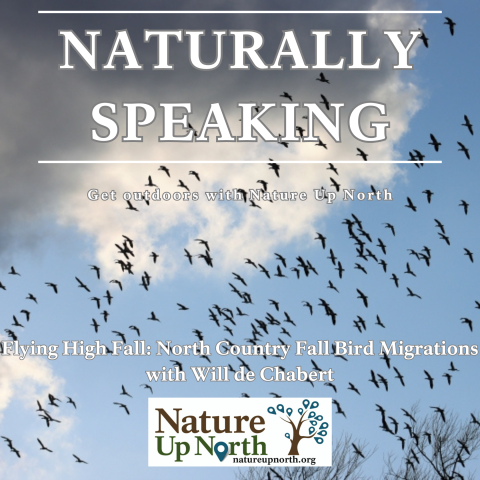
In this podcast, join Nature Up North Summer Naturalist Will as he talks with St. Lawrence University professor Sue Willson, an ornithologist, about the fall bird migration taking place in the North Country. Listen carefully for notes about bird species to keep an eye out for, their peak migratory times, tips and tricks on identifying some of these birds, and some of the threats these birds face as they fly through our part of the world. Sue even shares a few tips for helping them out.
Transcript
00:00:11 Will de Chabert-Ostland
Hello everyone, and welcome back to another edition of Naturally Speaking by Nature Up
North. I'm your host, Will de Chabert-Ostland. And today, we're going to be covering birds
and the full migration here in the north.
00:00:22 Will de Chabert-Ostland
During my junior year at Saint Lawrence University, I had the pleasure of taking
Ornithology, and originally, I was just taking it to fulfill my distribution requirement for my
major. However, throughout the class, I began to fall in love with birds, and today we are
going to be joined by the professor who sparked my interest in birds and taught the class.
00:00:42 Will de Chabert-Ostland
Hopefully, this podcast can instill some curiosity in our audience about the North Country
birds that we have.
00:00:50 Will de Chabert-Ostland
Alright, so today I'm joined by Sue Wilson, who is an ornithology and ecology professor
here at Saint Lawrence University.
00:00:58 Susan Willson
Hello. Will, I'm happy to be here.
00:01:00 Will de Chabert-Ostland
Glad to have you and today she's going to be joining me.
00:01:04 Will de Chabert-Ostland
To answer some questions about birds up in the North Country, especially in regards to
those birds that are migrating through here in the fall. So, I guess my first question to you
would be, what are some of the most interesting bird species that we might see migrating
in the North Country during the fall?
00:01:22 Susan Willson
Mmm. OK. Well, I think all birds are interesting, right? But beyond that, we do have a
number of species that I think people would be surprised to see, depending on who they
are. And so, for people looking for big birds, there are some really notable large birds.
That has just recently have become more common in our area, and that would be the Sand
Hill crane and the trumpeter swans. Both of these birds now breed in the North Country,
and so they'll be moving through. From areas further north, but they're also breeders here,
and so they'll be leaving in the fall. We have small populations, and both of those species
breed right now in the Upper and Lower Lakes Wildlife Management Area right here in
Canton. But they basically were extrapolated from the entire, either continent or eastern
United States for over 100 years, so they're slowly coming back. Both of those populations.
And it's because of wetland management. They both rely on wetlands. And so now that
there is protection for wetlands, these birds are coming back.
00:02:31 Susan Willson
Trumpeter Swans. You know, they're the heaviest bird in North America. There might even
be the world. They're about 26 lbs. They're enormous swans. They just look like a big white
boat on the lake. When you see them. But they basically were killed off by hunting. In
addition to draining wetlands for agriculture.
00:02:51 Susan Willson
But they were kind of a top bird killed to adorn women's hats for fashion, which is, you
know, you just have to think. My God, like nobody stood up for that. But a lot of these birds
that are coming back, you know, they were helped by the Migratory Bird Treaty Act, which
was passed in 1918. So that made hunting those of two species illegal. But because they're
long-lived birds with low reproductive rates. And they start breeding quite late. You know,
maybe like 6 to 10 years.
00:03:25 Susan Willson
They still have a very low population incline, right as they're coming back. And so, they're
both rare here in the North Country, but you'll see them migrating out of the area this fall.
00:03:38 Will de Chabert-Ostland
Yeah, I think that would be really cool to see. I've personally never seen him. And I mean,
I've spent my past three years up here, so.
00:03:44 Susan Willson
Oh, good. This fall is the time we'll find them for you. They're pretty easy to find. I did want
to note before you move on that for people who like smaller birds, there are, you know,
think of just north of here. We've got the Boreal Forest of Canada, right in Ontario and
Quebec. And so that is the home to about more than 80% of the population of warblers
that breed in North America, breed in that boreal forest, and so all of those warblers, the
boreal specialists that we could see if we're in the Adirondacks, we generally will see more
of on migration, and that would be like, gray cheeked thrushes, or Kate may Warbler, baybreasted
warbler, blackburnian warbler. You know. So, really cool birds that you otherwise
wouldn't see, and you may not even note that they come through, but unfortunately,
sometimes they're the birds I know come through because I find them dead under
windows on this campus, mostly in other places, so they are quite common migrants in the
fall, even though a lot of people don't know that.
00:04:50 Will de Chabert-Ostland
OK. Yeah. Awesome. So, I think that also led to the next question I had, which was the
lesser-known species that came through here. Do you have any other species that you
might want to highlight?
00:05:01 Susan Willson
Lesser-known species that migrate through well, I certainly see those boreal migrants. It's
certainly a time to go out at night on a clear night, and you know a lot of people don't
understand that birds, for the most part, songbirds migrate at night, right? Many people are
just like what, you know, when they hear that, they have no idea because they see larger
birds flying while all birds fly by day. But so are all the songbirds.
00:05:20 Will de Chabert-Ostland
Yeah.
00:05:30 Susan Willson
And shore birds will migrate at night, and so it's really just the larger birds like ducks and
Hawks that are migrating during the day. And so, on a clear night, like a clear, cool night in
the fall. If you go outside, you can actually stand in a quiet area and listen, and you'll hear
these; what they're called are flight calls of all of these different species that are moving
over, and there's a very specific, just “yip”, you know, whatever it is for a given species that
people are starting to learn these, just like we can now use software like Merlin or different
apps to understand bird songs, people are getting better and better at learning those night
flight calls so that you can actually put up like automated ARU's automated recording units
to know what's going through that? You'd actually have no idea of.
00:06:25 Will de Chabert-Ostland
So those night calls are definitely different than the normal songs and day calls. Ok so a
whole different range of vocal notes and all that.
00:06:28 Susan Willson
They're completely different and they're even.
00:06:34 Susan Willson
Yeah, it's not really like a song, you know, it's not this big, long, drawn-out song. It's literally
just like a pip, but because of the pitch of that, and you know what the bird is doing, if
you're really good at songs, you can actually learn some of those. But certainly, on a
spectrogram, you can see where it falls in with pitch and all the other parts of, you know,
like the vocal range and the complexity of that call to determine the species.
00:06:59 Will de Chabert-Ostland
Right. And I know, while answering that, you talked about one of my favorite apps, which is
Merlin. And so, if you don't know in the audience what Merlin is, it's basically free to
download app, you can press the record button, and it will give you a pretty accurate
suggestion of what the bird that you're hearing should be. I know I use that all the time
when I walk outdoors in addition to Merlin. How would other people in Saint Lawrence
County and the North County how would they know exactly what's going on a daily basis.
00:07:31 Susan Willson
Oh well, there's a very exciting app called birdcagebirdcage.info, and that's come out of a
lot of work at the Cornell Lab of Ornithology. So, I point my students to both of those, like
everyone has Merlin. But if you go to birdcast.info they use radar data to actually, in the
spring and the fall, you can look at it in the morning to see how many birds actually flew
over a given county. Saint Lawrence County in a given night, and it'll tell you, you know, like
2.6 million birds flew over Saint Lawrence County. They tell you the altitude. They tell you
the speed and the direction of those birds and you could do that with fall too, so you know,
here in Saint Lawrence County, a big night is something like, you know, like 3,000,000
birds. That's amazing. It's amazing. If you lived in Chicago or, you know, in the Midwest
Flyway, you could get a night where you have 10 million birds. And so it's dependent on the
area. But anywhere in the United States, you can put in your county and see that for both
the fall and the spring, and that's super exciting. So they'll give you a forecast of what
potentially is going to happen, but you can always look the night, be the night, the morning
after to see what that morning was like. And that can be really, really useful. You can even
look like real-time because they're uploading this information in real time. So you can right
now see at like 2:00 in the morning, if you can't sleep, you know you can see what's going
on, but it's super helpful for people who are monitors in cities that look for birds that have
hit windows of, for example, buildings and cities, and so they'll be pretty cognizant of what
is a big night for the next morning, looking for dead and or hurt birds.
00:09:07
Yeah.
00:09:11
Yep.
00:09:12 Will de Chabert-Ostland
And what was that website you mentioned, you said again.
00:09:14 Susan Willson
It's called birdcast.info.
00:09:17 Will de Chabert-Ostland
Awesome. And do you know how on the broadcast.info they are getting those real-time
projections?
00:09:24 Susan Willson
Yeah, it's all Doppler radar, so you know it's weather, weather, Doppler radar. And for
decades, you know, even a meteorologist on, like, on their newscast, they would kind of
ignore sometimes, you know, they'd show the forecast and show, like, what was going on.
And they would ignore, or perhaps every once in a while, someone would be like, Oh, and
look at that, that's biota, or you know, they have this like name of like animal junk. Like we
don't care about that, but um, acoustic biologists and people started looking at this stuff in
the 1970s, and so there's been an interest in using radar to look at bird migration for
decades. But now that we have kind of the really high-tech Doppler radar, they can actually
look at the size of the birds that are passing. They can't say hey, like that's a blackpoll
warbler, but it can be like warbler size versus shorebird size versus a duck.
00:10:23 Susan Willson
It's pretty amazing. Now, what they can look at.
00:10:25 Will de Chabert-Ostland
Yeah. So you're saying that they have gotten such advancements in technology where
they're able to be like, ohh, we think that's probably Raptor size, or we think that could be
like a Robin size, or.
00:10:37 Susan Willson
Correct. So, people are looking at that and can use that data to look at migratory patterns
of different species or groups of species based on Doppler radar information. Yeah.
00:10:49 Will de Chabert-Ostland
Yeah. So that's a really interesting way I know some folks who are either bird enthusiasts or
who want to monitor window collisions at home or something. If you notice a big night,
maybe go outside and see who's stopping over in the day, or just kind of scan those
windows and see if you can't find anything.
00:11:08 Susan Willson
Right. Absolutely. And that's a good point, Will, because a lot of birds as they migrate. It's
not like they're flying from the boreal forest in Ontario, Canada, to Costa Rica, right? Like
they're doing what you just said a stopover. And so, birds will fly for a night, and then they
come down at dawn, and then they rest during the day, and birds physiologically have
crazy mechanisms, physiologically, that allow them to do things like not sleep during
migration. So, you would think of you flying all night, you know, powered flight with your
wings. And then what are you going to do with dawn? You're going to sleep all day. No,
these birds eat all day. Right. And so, they just gorge. They basically do not sleep, or they'll
do a kind of hemispherical sleep while they're flying.
00:11:56 Will de Chabert-Ostland
Similar to what a dolphin will do if it's sleeping
00:11:58 Susan Willson
Correct. Yeah. And so, birds have a lot of mechanisms where they're, they'll shrink their
organs, you know, they do all this crazy stuff so that they just become these, like, evolved
machines for getting what they need to do for migration. But one of them means, yes, you
can wake up in the morning and look at your birdcast.info and say oh wow, it was a big
night. Go outside, go to your local forest or whatever, and you can find some of those birds
feeding, yeah.
00:12:24 Will de Chabert-Ostland
Yeah, yeah. And I know I mentioned a stop oversight. So, are there any particular key
stopover sites within the North Country or St. Lawrence County, and how are they critical
for migrating birds? And what's really the true importance of them?
00:12:39 Susan Willson
Yeah, you know, like there are so many species of birds, and it's not like one particular
habitat is the most important. Of course, large, protected areas are key. And as we have
allowed wetlands to recover and as we have allowed forests to recover, there's a lot of, you
know, any forest, whether it's protected or not, is going to have migrating birds in it. If it's a
standing forest, right? But places like the Upper and Lower Lakes, which are a big, big
wetland complex, are huge for any kind of aquatic birds, whether they're herons or rails or
shore birds, right or waterfowl.
00:13:16 Susan Willson
That's really, really important to have large, protected areas. Many of these areas do allow
hunting, right? So those ducks that are trying to get through, there's a lot of conservation
protection for waterfowl, and there's a lot of protection for habitat because of hunters and
basically, money for hunting licenses. And so, waterfowl populations have actually they
have, they've increased over the last 50 years, but individually those ducks are, you know,
going to these stopover sites and they may get shot because there is hunting. But you
know, here we've got the upper and lower lakes, that's key as in a wetland complex, and in
the forest that's around that, and it's a forest of different types.
00:14:00 Susan Willson
Stages, right? Because some of these birds like early shrubby growth, especially in the fall.
Remember, there are kids, right? And so interestingly, there's a lot of new research that
shows that even birds we consider interior forest species, right, like wood thrush or
Swainson's thrush or different warbler species, the young seem to, once they leave their
parents, they kind of get into these mixed species kid groups, and they are deliberately
going to this very brushy like, think of a really young early successional habitat where it's
like covered in like vines and bramble and stick it right because they are well hidden in
there, right? And often it's places that have blackberry and raspberry. So there's a lot of.
00:14:39 Will de Chabert-Ostland
Yeah, it just looks like a mess.
00:14:48 Susan Willson
Fruit eaters, especially things like thrushes and flycatchers. So, you've got birds going to an
edgy habitat that has a lot of fruit, and it has a lot of cover from things like sharp-shinned
hawks or Cooper’s, right? That may be hunting them. So, the kids in particular will seek out
this habitat that is just as important as, you know, a big old growth forest, so having a
variety of habitats as birds go through is key. So really, you know, it's like every habitat is
important. The grasslands are important, and just basically not having a super fragmented
habitat. That's all become urbanized and agricultural.
00:15:27 Will de Chabert-Ostland
Yeah, I know. Earlier this morning, we were actually on a program with Nature UpNorth at
Indian Creek Nature Center, which is inside the Upper and Lower Lakes Wildlife
Management, and we were leading this group of kids, and they were like, Oh my goodness
there’s so many bugs. It's so hot and all this like plant growth, like I can't walk off the trail,
and I'm like, I'm trying to tell, and I'm like, yeah, it's important to make sure that these
seemingly areas where you know it doesn't look as appealing for humans, it's really
appealing to a lot of other types of animals, and especially those young birds. So I think,
yeah, if you're ever in that area and want to check out some of those young birds,
especially in the fall, the growth, the shrubby growth, the stuff that doesn't look as you
know, pretty like you wouldn't have it in your yard most likely, but yeah, right along there.
Indian Creek Nature Center, which is just off County Route 14 near Rensselaer Falls.
00:16:25 Susan Willson
Yep, and surrounded by Upper and Lower Lakes. And so, you know regionally, of course,
the Adirondacks are important because it has less urbanization. The Robert Moses State
Park. You know these parks along the Saint Lawrence River, the Saint Lawrence River itself.
All of that is a super important habitat. And you've got along the river, the estuaries and the,
you know, the areas that are along the edge where it's not developed. All of that's going to
be very important.
00:16:50 Will de Chabert-Ostland
Right and with.
00:16:53 Will de Chabert-Ostland
All that area that's not quite as developed. And we're making sure it's maintained. Have
you been noticing any trends with climate change affecting either the bird species in the
successional habitats or the successional habitats themselves that have, like, started to
alter them?
00:17:13 Susan Willson
Sure. Yeah. I mean, you know. Like, yes, people, climate change is. Real right? Like come
on man, and to take money and funding away from that is a huge problem right now
because it's just getting worse. And so, one issue here in the North Country is invasive
plants, right? Every year, we hear about a different plant that's taking over wide swaths of
habitat, wherever that may be, or invasive insects that are taking out major trees that are in
the forest. You know, the emerald ash. Where are we going to lose our ash trees? Yeah,
then that's terrifying. That's like going back to chestnut blight from the 1930s and '40s.
So, both of those things are certainly exacerbated by climate change, and they really can
change. For example, good edge habitat can become a monoculture of Japanese,
knotweed, right? And that can be a nothing for birds that need something else it can
provide, perhaps cover.
00:18:05 Susan Willson
But perhaps not the correct food sources for, and it's a monoculture.
00:18:08 Will de Chabert-Ostland
Right. And when you say monoculture, it's that whole idea that there's just that one
dominant species. And it makes it hard for everything else to grow and function as well.
00:18:18 Susan Willson
Yeah. So, I'd say in terms of habitat, yes, there are all those invasives, the invasive insects
and the invasive plants. But then, climate change has also affected the ranges and range
expansion of some species. And this is, you know, more of an interesting thing. It's not
necessarily a bad thing because you think back to, like, well, in the Pleistocene, like birds
had to expand and contract those ranges with climate change. But, for example, I've lived
here in the North Country for 19 years, and I've been waiting patiently to hear a tufted
titmouse in my backyard. And last month I did, for the first time ever. First time ever.
00:18:46 Will de Chabert-Ostland
For the first time in 19 years.
00:18:48Susan Willson
You know, I just was, like, washing the dishes or something, and suddenly here. And they
have a very, you know, this, this whistle. And I was like, oh, there. So.
00:19:06 Susan Willson
That's climate change, right? So tufted titmouse? It's a very common species. If you go to
Southern New York, or if you go to New Jersey, where I grew up, you know, it's just there.
It's like a chickadee. But here they're spotty because we're right at the northern part of their
range, and they're expanding. Cardinals are the same way. So, Cardinals, we're on the
edge of their range. And really, they survive due to bird feeding, titmice would be the same
way in the winter due to the cold here. So, Carolina wrens are another one. So, there are
particular species of black vultures. Think of that. That's a tropical vulture.
00:19:38 Will de Chabert-Ostland
You're coming up here now.
00:19:40 Susan Willson
Yes! I saw one in Saratoga Springs a few years ago, so if you start kind of looking at eBird,
for example, another tool. Yeah, a citizen science tool where you can actually look at
particular species. Pick one of these right and go on eBird and look at it, and you'd be
amazed and say, like oh my God, people are seeing black vultures and Gouverneur or, you
know, like who knows?
00:20:00 Susan Willson
Yeah. Guessing on that one, but I saw one in Saratoga Springs, you know that to me. I'm a
tropical ecologist who works in the Neotropics. That's a tropical bird, and it's here.
00:20:08 Will de Chabert-Ostland
You're like that, you're like.
00:20:10 Will de Chabert-Ostland
Hello, why is that up here?
00:20:11 Susan Willson
It's crazy. So all of that, obviously is specifically, due to climate change.
00:20:16 Will de Chabert-Ostland
Right. I know you mentioned bird feeders, and we've also been talking on and off about
window strikes. So my question to you would be, what are some of the other, more manmade
threats, and what are ways that people living in the North Country can help manage
and protect some of the birds that we have up here, because I know we have a very good
variety. And pretty healthy bird population overall, but just, you know, improving that, and
especially for those species that you mentioned, like the sandhill cranes that are still
working their way back, how can we help them?
00:20:49 Susan Willson
Mm-hmm. OK. So for the large species, right, like the cranes and the swans, they're coming
back on their own. Right. So, Swans, potentially there was a -There is a- Reintroduction
program that's ongoing in Ontario for the trumpeter Swans, and we have been helped with
that, right? So some of the species that we have, some of the individuals that we have here
are very likely birds from that reintroduction program. They're doing okay as long as we
manage our wetlands and don't open a hunting season for either of those species,
because those two species are going to continue to increase here. For me, the biggest
threats, well, obviously. Habitat loss. That's always number one, right? So, if we can
manage habitat, and for me, the big one in the North Country is grasslands. People look at
an open area that perhaps isn't being farmed and say that's junk land that's not being used,
right? It's not being used by a farm, but.
00:21:50 Susan Willson
It is curial to grassland birds are the most declining group of birds in North America today.
And that's because of agricultural industrialization, right? So, pretty much anywhere that's
flat and has soil...
00:22:02 Will de Chabert-Ostland
It's going to be farmed now.
... we've put farms there like huge industrial farms. And so here it's corn and soy. And we
beyond that, we just, hay, right, there's a lot of cattle here. And so, people hay and
traditionally it used to be that people would hay, you know, late like July, and so to keep
bird populations going in grasslands, you know, you think of bobolinks in savannah.
00:22:31 Will de Chabert-Ostland
Eastern meadowlarks.
00:22:32 Susan Willson
Meadow larks, right eastern meadowlarks. These birds. It's not really safe to hay fields until
about July 15th. But everybody here thinks of like, okay, when do people hay in the North
Country? May.
00:22:44 Will de Chabert-Ostland
I know I've been seeing hay bales basically this whole summer.
00:22:47 Susan Willson
It starts late, May goes through June, and it's kind of like every, you know, every other
month kind of thing, but those birds are settling on what looks like perfect habitat. Right in
late April, meadowlarks are coming back or in April in May, you know, they're building
nests, they're laying eggs, they're incubating, and then they hatch out those kids, and
across all those stages, they are getting mowed. So eggs, nest's baby chicks are getting
mowed every time haying happens.
00:23:20 Susan Willson
What do you do? You know, I understand that people want to pay early because the protein
content is higher in the hay. I have goats, right? I buy hay for my goats. There are programs
that reward people. There's actually. It's like the Bobolink Project is one that will pay
people. Specifically, some states will pay farmers as well to hay later, and it's X amount per
acre based on the number of acres you have. You know bigger is better to not hay, so that
you'll get a population of these birds instead of.
00:23:50 Will de Chabert-Ostland
Right. And that's just to preserve, yeah, to preserve those bird species and help them nest
during the summer.
00:23:56 Susan Willson
Correct. Because they're declining so horrifically, but even to get them on your land, you
have to have a minimum of like 30 acres of intact open grassland, right? If you have a little
patch that's like 5 acres, forget it.
00:24:10 Will de Chabert-Ostland
They're not going to come.
00:24:10 Susan Willson
Know maybe you'll.
00:24:11 Susan Willson
Have a bobolink sing there and then he's just going to leave cause he's not going to attract
a female. And so for me, grasslands are crucial, and we need to preserve them now. And
that would be the number one habitat here in the North Country that I'm concerned about.
00:24:24 Susan Willson
Beyond that, it's windows and cats, right? And so.
00:24:25
OK.
00:24:27 Susan Willson
So, windows. All you need to do is just put something on those windows that shows birds
that that pane of glass is not a nothing, right, like birds don't see glass, they're going to fly
30 miles an hour...
00:24:41 Will de Chabert-Ostland
Right. So you mentioned that they don't see glasses. There's something that goes on
biologically as to the reason that they can't see the glass.
00:24:48 Susan Willson
They just can't see it. Like you know, they didn't evolve in these, you know, built
environments like we do. They just don't get it, like and so they'll see, you know, people
have potted plants inside or often these, you know, I saw one at Clarkson yesterday, an
aerial walkway where there's glass on both sides. And I.
00:25:03 Susan Willson
Was like, oh, that's.
00:25:04 Will de Chabert-Ostland
And you're like the poor birds just going to think, I can just fly right thought it.
00:25:06 Susan Willson
They just see the trees on the other side, right? But even a lot of glass reflects the trees on
the outside, right? So it's often reflection based on the time of day.
00:25:16 Susan Willson
The best thing to do is to put a treatment on the outside of the glass we're trying to more,
that is as much as possible here at Saint Lawrence University. Right. We use something
called Acopian Birdsavers. You can go to birdsavers.com. It literally is paracord, like a thin
quarter-inch, but it's like a nylon cord, and you basically secure it on top of the window. It
hangs vertically every 4 inches outside the window in a snap on your own home. You could
even use a bar of soap. And so I had a junco hit, one of my windows at my home house, it's
in a weird position, but it's on the 1st floor, and so I just go out with my ivory soap and I put
lines on the outside of that window because I don't want more birds to hit that window.
00:26:05 Will de Chabert-Ostland
Right. Just so they can see it and be like, Oh, I can't fly there.
00:26:07 Susan Willson
And it's in the back. So nobody's going to see it. And it's like, it's great, but this paracord is a
really wonderful solution that is not costly. And you could do it yourself. There are other
things, like bird friendly window films that you can. There's one called Feather Friendly. You
could look that up, but it's more it's it costs more. But for some companies, you know, they
want something that they think is prettier. I think the paracord is very pretty, and it kind of
has a Zen-like look where it's just these hanging lines.
00:26:41 Will de Chabert-Ostland
I know for our listeners, if you've never seen the paracord, there's some actually on the
Johnson Hall of Science on Saint Lawrence campus. It's on both the North and South
facing windows, too, I guess, aerial walkways that have them. And I mean, I noticed when
they came up because I was off campus during the fall, and they were up in the spring.
When I came back last year, I was like, oh, it just looked like, oh, it looked like there was
like a little renovation, and it's nothing major. I mean, it doesn't change the beauty of the
building, really at all.
00:27:10 Susan Willson
No, I'm super proud of that. My students and I collected about a decade's worth of data to
present to the university to show that it was one of the worst places on campus for birds
hitting windows. And since they have been up, they were put up last fall, 20 October 2024,
have not received or seen a single bird that has hit those areas of Johnson on the north and
south side, and the walkway to Beweks. And that's a win, right, like shows how well they
work. And again, I guess I would say you know a lot of people, when they think about
window collisions, they'll say like. Oh. That's a problem for cities, right? And it is, you know,
there are some. You can be a window collision monitor in Chicago or New York City, or pick
your city, and they'll have days of, you know, dozens of birds per day. You know, they get
more than 1000 a in a migration. But residences, too, you know, homes.
00:28:08 Will de Chabert-Ostland
Yeah.
00:28:10 Susan Willson
Have birds hit all the time, and so that's an individual thing where you don't have to. Kind of
force or beg. That company should put something on the window or shame them enough.
But it's getting people to do that in their own homes, and it's very easy to do so. One is the
power cord for the windows, Acopian Birdsavers or birdsavers.com. You could look at that.
And two, its cats, right? And so, I've done a ton of research on cats killing birds. Look at the
American Bird Conservancy. If you look at Audubon Society, like, pick your bird society
everything is cats indoors, and I stand by that. Of course, cats are the worst invasive
species on the planet. OK, besides humans, maybe we're not invasive, but we're
everywhere. But cats really are. We've brought them everywhere with us. Cats and rats do
horrific damage to bird populations everywhere they are.
00:29:01 Susan Willson
UM.
00:29:02 Susan Willson
In places like the North Country, many, many people have cats that go outside, barn cats,
right?
00:29:07 Will de Chabert-Ostland
Right, like barring cats and that stuff, just, you know, to eat the rats and stuff that we also
brought.
00:29:11 Susan Willson
Yeah. And so, one thing that I've done a lot of work on is something called the Birds Be Safe
Collar Cover, and it's, you know, you can go to like birds, Google Birds Be Safe, and you'll
find this, but basically, it's like a cloth sleeve that goes over a collar. You can use a cliprelease
collar or a buckle collar. There are buckle collars that have strech in them. I prefer
those because they stay on better than the quick release. Clip collars have a high failure
rate, but anyway. They're brightly colored, patterned, and think of birds versus mammals,
right? Birds have incredibly good colors. Their vision mammals besides humans, most
mammals see in a kind of gray scale with a little bit of color thrown in. But birds have
exceptionally good color vision, so it basically breaks up the pattern of that creeping cat
creeping up on a bird, and studies that I've done have shown that they're between like 65
and 95% effective at keeping cats from killing birds, and that's huge. That is not going to
save all grassland birds, right? It's not something like that where we're talking about
populations of what we can do for eastern meadowlarks, but for owners of cats who
decide to have their cats outside or have an outside cat. This is a concrete thing one can do
to keep your cat from killing birds, and that's important, right? Because it's traumatic and
it's like every little individual thing counts. You can't take the shoulders of everything on you
for, you know, the problems of the world. But you, each individual can do something if you
own a cat and its an outside cat it should have a caller on. Right?
00:30:54 Will de Chabert-Ostland
Yeah, it's a pretty safe and effective way to.
00:30:56 Susan Willson
It's very, very effective. It's way more effective than just like bills on a collar, for example.
So that's one thing I think that you know each individual person out there can be thinking
about windows and they can thinking, be thinking about their cat and how to keep their cat
from killing birds. And those are fixable, solvable problems.
00:31:17 Will de Chabert-Ostland
Nice. So that I think that's a good way of at least getting some positive out there and being
like oh, we're having birds declined. But wait, there's something we can do at least.
00:31:24 Speaker
Yes.
00:31:25 Will de Chabert-Ostland
My next question for you would be that you've seen over the past, I guess, 19 years that
you've been here. What, what has been some of your favorite fall migration sightings or just
anything that you that really like tickles your brain up there and?
00:31:38 Susan Willson
Oh, okay. You know, like, since we're on migration. To kind of think seasonally and for me. I
live just a few like 3 miles South of SLU, and one of the most beautiful, beautiful things that
I have had happened in the last maybe 6 plus years is that I have a small wetland behind
my house. There's a meadow and there's a wetland, and because of that every fall and
spring.I get trumpeter swans and sand hill cranes now coming over my house back there.
You know, I see them in the meadow and that's a win, right? Like, that's such a
conservation win for me. A bird biologist who knows the history of these birds knows that
they were basically extrapolated. And they're in my backyard, you know? Like, so that's.
Very exciting in terms of migration, I think it's important to remember that, it's not that all
the birds are leaving, you know, like winter in the North Country people are like, Oh my
God, you know, it's hellish, and there's nothing but if you're a bird or in the North Country,
there's a whole well, it's a whole new slew of birds that comes from the north and they
come specifically here to winter. So they're not even passing through. They are now here.
00:32:55 Will de Chabert-Ostland
They stay up here the whole time.
00:32:56 Susan Willson
So we have incredibly amazing birds here like I had my whole Ornithology class see a flock
of bohemian waxwings, right? So, we had 30 bohemian waxwings which you don't see
other times of year. There's a lot of Hawks that are here like rough legged hawks, many
more eagles. You know it's like you can see a bald eagle every day. In the winter, because
there's so many that come down, we also have golden eagles that come down in the winter
and set up shop here and hang out so many, many songbirds, you.
00:33:28 Susan Willson
There's another bird that I work on personally is the evening grosbeak, and so that's a funny
bird because it's a big, big finch, right? And so, anyone who's hearing this, who's lived in the
North Country, perhaps or grown up in the North Country, this is a bird that goes to bird
feeders. And if you've lived here a long time, you may say I remember that bird that big
yellow and black and white bird with that huge gigantic seed crushing bill. They were
common here, let's say - 40 years ago.
00:34:01 Will de Chabert-Ostland
40 years ago. Real common, yeah.
00:34:02 Susan Willson
Or more now.
00:34:05 Susan Willson
Now, they're not here. And so every once in a while, a couple every couple of years, get
what's called an eruptive movement. And these are these birds that are moving, looking for
food, right. It's not this kind of back-and-forth migration like we think of a normal
Neotropical migrant. But evening groseaks on a good year when maybe the seed crop of
what they want for particular cones, you know, they're going to like different pines or fir or
spruce or sumac or what have you like dried fruits. If those fruits are not as good in
particular places in Ontario or Quebec; the birds will flood down into the Adirondacks, and
so we had a Goodyear a few years back where Tupper Lake was dripping with evening
grosbeak. I took my Ornithology class. I guess it was four years ago. You know, and we saw
hundreds, you know, it was like, bizarre, right in downtown, you know? And like, on
somebody's residence?
00:34:57 Will de Chabert-Ostland
And you're like, we don't see these birds all the time anymore.
00:34:59 Susan Willson
No. And the students were like, yeah, whatever. You know, I'm like people. These are this is
not common. But that also needs to be appreciated here in the North Country that we have
birds here in, not just kind of moving through but coming in in a particular season and in
this case, winter snowy owls, right are one that we get almost every winter, but there are
some winters where we'll just get a big movement of snowies into the area. And you can
find them and see them. And you know, like my God, to see a big white owl here in the
North Country is it's it's such a thrill and it's it's very remarkable. On top of that sometimes
we get great gray owls. You know, we've had great Grays come to places like Robert Moses
State Park up along the Saint Lawrence River. I had the pleasure of watching two there,
couple years back. They were hunting and one of them actually hunted and caught in
ermine while we were watching, you know, which is a predator, an ermine, a weasel and
so.
00:36:02 Will de Chabert-Ostland
And so it didn't. It didn't just get a mouse.
00:36:03 Susan Willson
No, these are huge owls, right? And so it grabbed ermine and so there's a lot of very, very
special birds up here that people from the south, you know, think of New York City.
Whatever will come in the winter specifically to see because they can't find them anywhere
else in the northeast.
00:36:22 Will de Chabert-Ostland
And that's really pretty cool. I've been a student at Saint Lawrence. I'm going to go into my
senior year, so I've been here for a few years. But between studying abroad and stuff, I
haven't been around here in the fall as much. This falls the time I think, especially for me. I
know it is my first year here. I was like, oh, yeah, there's birds. I'm like, cool, sure,
whatever. And then I think where I am at this point and just, you know, gaining that sense of
appreciation. I'm actually going to go out and really heavily look and be like, oh, that's what
I can actually see here and I think it's. I think it's really special because I come from more
of an urban area and southern Connecticut and I've just been surprised so much this
summer. By every time I drive, how much wildlife is actually up here. So, I think this is a
really special thing that everyone up here in the North Country has.
00:37:16 Susan Willson
I think I just want to speak to that really quickly because birding is difficult, right? Like it's a
hard thing to get into one you need binoculars. And binoculars used to be like, oh, there are
like $500 or six, you can get good binoculars for, you know, like 150 bucks now. Yeah,
that's still a lot of money, but they help, you know, it opens up the whole world of looking
for birds. And you don't want to get junk binoculars. I like what are they called? The vortex
binoculars. They're about $150.00. That's a good entry level. They have very good optics
and they have a lifetime warranty. So, I know getting into burden can be hard, but binocular
prices have come down and now that we have things like the Merlin app, you know where
you can literally stand in your own backyard. Hold up, Merlin, press play and it's recording
the birds and telling you like it highlights the bird as it sings. It's a really remarkable way for
people to learn bird songs and learn what's in their backyard. I love getting people excited
about birds, so if you're listening and have questions about birds, let me know or let Will
know because he knows a lot about birds now too. But I'm very happy to talk about them as
much as possible.
00:38:32 Will de Chabert-Ostland
Thank you so much, Doctor Wilson, for coming in.
00:38:35 Susan Willson
OK, you're welcome, Will.
00:38:37 Will de Chabert-Ostland
Thank you all for listening to my conversation with Susan Wilson. We hope you enjoyed
learning about the different species of birds that migrate here in the fall, the importance of
stopover sites, ways you can help protect birds and some of our favorite bird encounters
here in the North Country. Stay tuned for our next podcast. And as always, until then, get
up and get outdoors with Nature up North.