
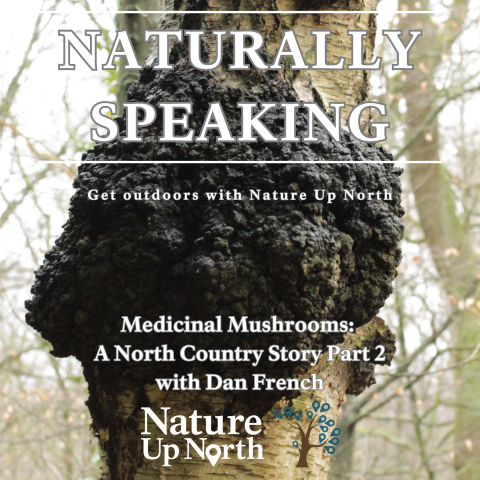
When we left off in Part 1 with Kaitlin Lawless, she had just finished telling us about Birch Boys Incorporated, her path to the vice presidency, and what it takes to be a sustainable harvester of chaga and other mushrooms here in the North Country. In Part 2, we're going to continue that conversation by getting into the habitat that these mushrooms rely on, what impact the short-term changes in weather are having on that habitat, and what the outlook is for the health of these mushrooms and the longer-term trends of climate, and what Birch Boys Incorporated is doing to help with their harvesting practices to alleviate that pressure.
Transcript
00:00:14 Dan French
Welcome back to another episode of Naturally Speaking. This is your host, Dan French, Project Manager for Nature Up North, and this is part two of my conversation with Kaitlin Lawless, Vice President of Birch Boys Incorporated in Tupper Lake.
00:00:26 Dan
When we left off with Kaitlin, she had just finished telling us about Birch Boys Incorporated, her path to the vice presidency, and what it takes to be a sustainable harvester of chaga and other mushrooms here in the North Country.
00:00:37 Dan
Today, we're going to continue that conversation by getting into the habitat that these mushrooms rely on, what impact the short-term changes in weather are having on that habitat, and what the outlook is for the health of these mushrooms and the longer-term trends of climate, and what Birch Boys Incorporated is doing to help with their harvesting practices to alleviate that pressure.
00:01:05 Dan
So getting back to the core here, the conditions these mushrooms grow in and how they're changing. Beyond what you've mentioned, the temperature, the wetness, and the relationships to particular trees, at least in the case of chaga and reishi,
00:01:18 Dan
Are there other conditions that would be ideal that these mushrooms are looking for beyond those 3 to qualify as like a proper habitat space?
00:01:27 Kaitlin Lawless
That's a really cool question. And fungi are a seriously overlooked kingdom of life. They're basically the glue between the other kingdoms of life.
00:01:37 Kaitlin
So they will grow pretty much anywhere you have moisture. You won't see a lot of fungi in the desert. You won't see a lot of fungi in like white cedar swamps because white cedar is naturally antifungal.
00:01:51 Kaitlin
It's a little tough for me because I live in a white cedar swamp, so I have to travel when I go mushroom hunting. But essentially, yeah, the most two important factors for mushroom growth is going to be precipitation and weather.
00:02:07 Kaitlin
Chaga in particular likes very, very cold weather, but there are a lot of mushrooms that can abide by like a wide range of temperatures. And then even ones that can handle warmer temperatures, when you think of things like Aspergillus being something that can infect people, that's because that fungus can withstand our body temperature, and that's a disease you see commonly in elderly people who do a lot of gardening and stuff because Aspergillus is in the soil, right?
00:02:31 Kaitlin
But essentially, you know, they can tolerate a wide variety of climate, mushrooms in general, not really chaga, it prefers the cold. But basically the two indicators of your fruit is going to be... It depends actually on the kind of mushroom.
00:02:48 Kaitlin
For fungus that is symbiotic with trees, mycorrhizal fungi that kind of help process nutrients for vegetation, they have this symbiotic relationship. Their health is actually, so like if we're talking about how they fruited this year, that would actually be very dependent on how the health of the canopy was last summer. And that's because, you know, the strength of this vegetation, it's a mutualistic relationship feeds back into this mycorrhizal fungi.
00:03:14 Kaitlin
We, however, work with saprophytic fungi. So those are the decomposing fungi, and they actually have a different set of standards that they need to grow. It's much more based on the amount of precipitation within that month, as well as the weather overall. And so Garrett has a great blog on our website if anyone's interested about the sustainability of reishi actually. And there are certain temperatures, you can actually track the temperatures in Tupper Lake to see when it hit a certain low and use that to predict how many flushes and fruits of reishi you're going to end up with that year.
00:03:52 Kaitlin
So it's very weirdly temperature dependent. And I was doing some reading this morning just on climate change and mushrooms in general. And so in Europe, where the climate is also all over the place, but around the Mediterranean, they're actually not seeing a decline in overall yield. They're seeing the same amount of yield because the growing system season has lengthened.
00:04:14 Kaitlin
However, I don't think we'll see that here because it gets quite cold here and the moisture is such a big part of it. So I'm interested to see how rising temperatures affect, the Adirondacks as a whole going forward.
00:04:31 Kaitlin
What I can say definitively is that last year I could not take a walk on my plot of land without seeing a dozen, two dozen different species of fungi, fairy clubs, chaga, artist conch, orange mycena, all sorts of different really interesting fungi.
00:04:51 Kaitlin
This year, really, really tough to find anything. And everything I did find, so like last year with a very, very moist season, I found a lot of turkey tail on standing deadwood. Turkey tail is our most important mushroom to actually bring in every year because it is feather light. It is really annoying to harvest. You can get paper cuts on it, all sorts of little things. And then you spend a lot of time harvesting it and you yield an absolutely pitiful weight.
00:05:20 Kaitlin
So that's one of the ones we're most interested in harvesting. And last year, I found most of it on standing dead wood on the side of the tree.
00:05:28 Kaitlin
This year, 0 mushrooms. I have 60 acres that I walk pretty much every couple days with my dog. No turkey tail on standing dead wood. The only place I found turkey tail was the underside of logs. So touching the ground, because nothing, like the overall wood structures are just not moist enough to sustain that.
00:05:50 Kaitlin
So in dry periods, the mycelium, kind of the seed, if you will, of the mushroom, is able to hunker down and survive, but it will affect how much it can fruit in addition to the precipitation affecting how much it can fruit.
00:06:07 Dan
Yeah. You're giving me a perfect transition into my next kind of question here, because the penultimum finish of all of this is, I guess, how you guys are adapting to changes you're seeing year over year, season over season, and maybe long-term. And correct, I just want to make sure I have this right.
00:06:24 Dan
So there are two families of mushroom, the one that is symbiotic with the tree that looks at the previous season's conditions to kind of determine how it's going to do this year.
00:06:33 Dan
And then the mushrooms that you dominantly work with, the ones that are the decomposers, that are more concerned with the immediate conditions they're experiencing the last month.
00:06:42 Dan
Do I have that right?
00:06:43 Kaitlin
Yes, I'm sure there's more, those are called guilds. I'm sure there are more guilds that I'm not touching on. But yes, the saprophytic mushrooms really depend on like the mulch, the mulch layer in the forest and the moisture. And so that isn't as affected as this kind of, transference between the vegetation and the fungi.
00:07:06 Dan
Yeah. Well, I'll ignore the symbiotic ones then, since those aren't the ones that you deal with for now.
00:07:11 Dan
And asking about the decomposing mushrooms, when it comes to long-term outlook for the business and the work that you do with mushrooms, especially if these mushrooms are more responsive to the immediate changes in condition.
00:07:26 Dan
So my initial plan was to talk about last year versus this year. And it seems to me that what your answer would be is that last year, as you said, was very successful in the terms of these mushrooms.
00:07:33 Dan
We had a ton of rain, a much longer summer before winter hit, at least a summer, maybe poor description, but a longer potential growing season.
00:07:41 Dan
And this year we had so little rain until today, it seems, that there wasn't really much of a season. I got one I should ask. Do you anticipate many mushrooms growing before winter hits here at this point?
00:07:52 Dan
We're in, where Halloween is tomorrow and we're getting cold rain now. I don't know if that would be too short for these mushrooms.
00:07:59 Kaitlin
I mean, that's a great question. I would love to say, I know exact, because right now my mind's on turkey tail. Harvesting season for turkey tail is like starts in September.
00:08:09 Kaitlin
And so to have such an early October frost, which is not actually early for this region, but compared to the last few years, like you were saying, it is kind of early, gutted me a little bit because I was pretty worried.
00:08:22 Kaitlin
I found like maybe six or seven gallon bags of turkey tail this year, which isn't really in the grand scheme of things very much. So yeah, I don't worry about our ability to continue as a business, there are definitely ways to find these mushrooms. And really, actually, because our business does focus on the medicinal potency of these mushrooms, there are some important distinctions there.
00:08:47 Kaitlin
Like lion's mane and maitake, they, and even turkey tail, are not really attached to a specific type of wood substrate. Their benefits come intrinsically from the fungus. So with lion's mane, your active compounds are like mostly triterpenes and diterpenes, hericinones and arenesines, and those come from the fungus itself.
00:09:11 Kaitlin
Whereas chaga, your main compound is going to be betulinic acid. That's actually stolen from the birch tree. Chaga doesn't make that on its own. And so chaga can grow on other trees like maple and ironwood, but we don't harvest from those because they don't contain the medicinal compounds that we're looking for.
00:09:33 Kaitlin
So there are some fungi that rely really heavily on their substrate for their benefits, and there are others that don't.
00:09:39 Kaitlin
So maitake, lion's mane, turkey tail, Cordyceps is actually one of those. They have intrinsic value within the fungi.
00:09:48 Kaitlin
Whereas something like hemlock reishi, Ganoderma sugae, North American reishi, they have a million names, all of them. That needs to grow on hemlock in order to have the compounds that make it a calming substance.
00:10:02 Kaitlin
Chaga needs to grow on birch in order to have the immune supporting compounds.
00:10:07 Kaitlin
And so those mushrooms are the ones I would worry about more.
00:10:11 Kaitlin
In chaga, however, we have such an abundance of it and our cultivation efforts are going pretty well, all things considered. That's actually less of a worry.
00:10:21 Kaitlin
So, you know, our turkey tail, what I will say, because I've tried cultivated turkey tail and I've tried our wild turkey tail. The flavor is wildly different, wildly different.
00:10:33 Kaitlin
Our turkey tail from up here tastes, it's very umami, almost like a broth and has almost a pine flavor to it. Like think almost like a lemony chicken broth. It's not chickeny, but it's kind of that savory flavor with a little hint of that kind of citrusy pine.
00:10:50 Kaitlin
Whereas Turkey Tail we've gotten from elsewhere does not have that flavor. It's not nearly as pure tasting. I don't have a great description of what these other ones taste like, kind of more like leaves or more like mushrooms, right?
00:11:08 Kaitlin
Whereas even our chaga up here, our customers who have had chaga from all over the world say that it tastes the best up here. And I think that's just because we live in the best place in the whole world.
00:11:19 Dan
Definitely. So Birch Boys Chaga or Birch Boys Incorporated is a decade plus old now.
00:11:25 Kaitlin
10 years. It'll be 11 in January.
00:11:29 Dan
Okay. So when it comes to the mushrooms that you work with, again, it's the short-term weather and that can change year to year as we've seen in 2024 with the hurricane that came through and this year with the drought.
00:11:40 Dan
But have you noticed any longer term trends either in, over the course of a decade, we're starting to get into climate more so than we are weather.
00:11:49 Dan
So, and I know most of what I'm interested in when it comes to work is invasives. I know that they're slowly marching north as temperatures tend to increase in this area gradually over time.
00:12:01 Dan
Are you seeing changes in maybe the demographic of mushrooms you're seeing or in their yields over a longer term? Or is that remaining somewhat steady?
00:12:13 Kaitlin
As far as I know, that's remaining pretty steady. You know, we do GPS tag a lot of our chaga trees and the rate at which they, you know, we see a new growth of chaga and we take down a full tree of chaga is actually pretty pretty equal, which is nice.
00:12:31 Kaitlin
I've really started doing my own harvesting and foraging within the past three years, so I can't really speak to the broader decade-long trend that we have going on here, but we have never been in short supply of chaga, which is very lucky for us.
00:12:45 Kaitlin
Actually, a big thing that made us successful was that during COVID, every other company ran out of chaga. And that's why we got kind of a really big infusion of business at that point in time, because we were the only people who had it. And of course, immune support, people were looking for that kind of thing during COVID.
00:13:04 Kaitlin
And so we are just really uniquely poised to, we call ourselves the best quality supplier of North American wild chaga. And it's, that's a fact.
00:13:16 Kaitlin
A lot of brands that actually are a bit more popular, a bit more name recognized than as sourced from us. And those aren't always things that we can disclose, but our chaga is highly sought after being from the Adirondack Park.
00:13:28 Kaitlin
So we're lucky because we have a ton of it. But yeah, to speak to the greater overall trends with chaga, I have not noticed anything. With the other mushrooms really depends on the heat.
00:13:39 Kaitlin
I know from my own homestead that I have, invasives get worse and worse every year with the increasing heat. Garlic mustard is, all the invasives are so much more resilient than our like sensitive native, native crops. And I live in a little boggy area, and so we have like trilliums and bog plants that really prefer the shade and the cool, temperatures and they're getting harder and harder to grow. But, you know, the non-native hibiscus are doing better and better. Yeah, it's crazy.
00:14:11 Kaitlin
So in terms of fungi, what we tend to see is basically they're really rapidly evolving. So we'll see fungi hybridize with other fungi. We'll see fungi like Rishi even grow on a yellow birch tree.
00:14:27 Kaitlin
And then there's even genetic like variances between the same exact fungi. So the genes will be exactly the same, but the phenotype or how it looks will change based on what environment it's on, what tree it's on. And so the biggest overarching piece of knowledge about fungi and the changing climate is that they're incredibly resilient and they're going to continue to be however they need to be. They're going to hybridize, they're going to become more cold tolerant, they're going to become more heat tolerant and things like that.
00:14:59 Dan
Yeah, obviously with the invasives you've just talked about, they tend to spread more with the heat, I think, at least in my experience. But you mentioned that mushrooms can also become cold tolerant there, which is a perfect segue way into the other thing I'm curious about, which is more than likely this podcast will be released when the ground is covered in snow. And I'm wondering if there's any winter specific either mushrooms to look for or if there's any specific mushroom practices that happen during the wintertime?
00:15:24 Kaitlin
Absolutely. So the biggest one I have to mention first is that a lot of people think you can only harvest chaga in the winter. That's actually a myth. You can harvest chaga any time, but it's much easier to find it in the winter because all of the leaves have fallen off the tree. So that's definitely the biggest one.
00:15:41 Kaitlin
And then up where we live, and I think in a lot of areas with a colder climate, you can actually find enoki mushrooms in the winter. They like to fruit in the winter. And so when you think of enoki mushrooms, a lot of people will think of the enokitaki that you see in food.
00:15:57 Kaitlin
They're like this pretty little spindly clump of white mushrooms. And the wild variant actually looks very different, but it's still edible. So that is one that you could find pretty much in either early winter or late winter, not in the depth of winter.And you can eat that one.
00:16:14 Dan
Cool. Well, those are all the questions I had for today. I know from looking at your website that you have a wealth of educational material and other resources. So I wanted to give you an opportunity to brag about anything on your website that you might want people to visit as part of this podcast as well to get more information.
00:16:29 Kaitlin
Absolutely. So we do have, we have a lot of blogs about specifically chaga ecology. I know we have one on, we have a big overall blog. We've got one on when the best time of year to harvest chaga is. That can be a controversial question in the chaga realm.
00:16:45 Kaitlin
We also have a big sustainability blog for reishi. We have, I wrote basically a dissertation on the different species of reishi that you find in the supplement industry and how they differ from each other and how there's a bit of wool being pulled over the eyes with a lot of that in the industry. So there's really interesting information, whether you're interested in just reading about the healing history of the Adirondack Park or learning a bit more about fungi.
00:17:11 Kaitlin
You can find it at birchboys.com.
00:17:13 Dan
Definitely. I also noticed plenty of warnings for folks trying to go out and identify their own mushrooms to harvest. So before any of our folks go out and try to get their own mushrooms in their own backwoods or somewhere, is there any tips and tricks you'd have for identifying or avoiding identifying, trying to identify certain mushrooms.
00:17:29 Kaitlin
Yeah, so we're lucky. Tree mushrooms, all in all, in the United States tend not to be harmful.
00:17:36 Kaitlin
There are two species of tree mushrooms that are not very commonly found in the US that are harmful. But that being said, I get a lot of people who like send me pictures of like burls, burls of wood, That is not chaga, or tinder fungus, which is not chaga.
00:17:54 Kaitlin
So essentially they're just taking something out of the environment that doesn't need to be taken out of the environment.
00:18:00 Kaitlin
One thing that comes up a lot is, my grandson got me some chaga and it tasted like dirt. It tasted bad. And that is when people harvest rotten chaga.
00:18:12 Kaitlin
You cannot take chaga from the forest floor. It's bad. You have to take it from the tree or just after it is reproduced from the tree.
00:18:20 Kaitlin
So, you know, there's, it's less that there are some outright dangers with tree fungi, don't quote me on, ground fungi. Those, don't mess with those if you don't know what you're doing.
00:18:31 Kaitlin
But in general, the logic is, you know, have three absolutely credible sources of identification backing up your assumption. And so there are a lot of apps these days that will ID things, and they're great with plants.
00:18:44 Kaitlin
They're terrible with fungi. If you're interested in harvesting fungi, that's kind of a hobby you got to get into. And you definitely want to be careful and you don't want to poison anybody. There was that big mushroom poisoning trial out of England recently.
00:18:58 Dan
Yeah, I didn't hear about this.
00:19:01 Kaitlin
Yeah, a lady killed her family with some mushrooms. So yeah, it can be really dangerous. You got to know what you're doing. In New York State, you actually have to be a licensed identification expert in order to sell fungi.
00:19:14 Dan
Thank you again, Kaitlin, for coming in and speaking with me today and sharing everything you know about mushrooms with myself and our listeners. I know that I learned a lot today about chaga and some of the other mushrooms that Birch Boys Incorporated is working with.
00:19:25 Dan
For those listeners at home, if you want to learn more about Birch Boys and the mushrooms that they're using to create their tinctures, teas, and other products, you can go to birchboys.com or you can find them on Instagram and I believe Facebook if you search Birch Boys there as well.
00:19:40 Dan
This was another episode of Naturally Speaking with Nature Up North. I was your host, Dan French, Project Manager for Nature Up North. And after you listen to this podcast today, be sure to check out our website for other upcoming events, blogs, podcasts, and any other information. and you can get up and get outdoors with Nature Up North.