
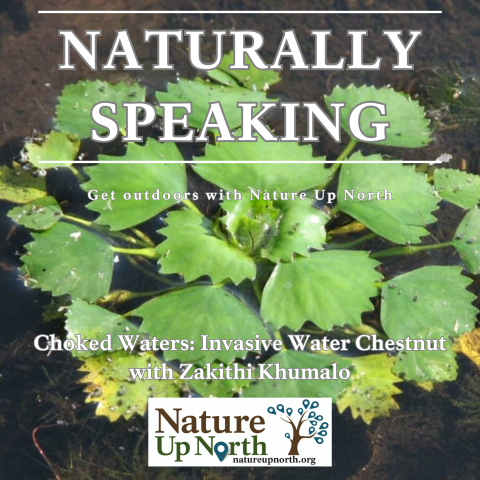
In this episode of Naturally Speaking, Zakithi explores the growing threat of invasive water chestnut in Northern New York’s rivers and lakes. Joined by researchers Brad Baldwin and Peyton Robbins, and Megan Pistolese-Shaw from SLELO PRISM, we dive into how this plant spreads, its impact on local ecosystems and communities, and the ongoing efforts to control it. Whether you're a paddler, angler, or nature lover, find out how you can help protect our waters. Get involved with SLELO PRISM at sleloinvasives.org/events, or sleloinvasives.org/pledge-to-protect. You can also learn more about the DEC’s Protect Our Waters work at https://dec.ny.gov/nature/invasive-species/aquatic/prevent-spread-of-aq…
00:00:16 Zakithi
Hi everyone and welcome back to naturally speaking, I'm Zee, a junior at Saint Lawrence University and one of the Nature Up North Summer Naturalist interns.
00:00:26 Zakithi
Today we're diving into a topic that's affecting our rivers, lakes and local ecosystems, sometimes without us even realizing it.
00:00:35 Zakithi
You've probably paddled through thick mats of green or seen strange floating plants along the edges of the Oswegatchie River.
00:00:43 Zakithi
Those might just be invasive species, plants that don't belong here and end up spreading aggressively, choking out native wildlife, damaging boats, and even altering entire aquatic ecosystems.
00:00:56 Zakithi
In this episode, we're focusing specifically on the invasive water chestnut.
00:01:01 Zakithi
To help us understand how this plant affects our waters, I speak with Brad Baldwin and Peyton Robbins, two researchers tracking how water chestnut spreads across our waterways.
00:01:11 Zakithi
I'll also speak to Megan Pistolese-Shaw from SLELO PRISM, a conservation partnership that's helping communities fight back. So, grab your paddle or just your headphones and let's explore what's lurking below the surface.
00:01:30 Zakithi
Water chestnut may sound like something pretty harmless, but it's quite a serious problem. It forms thick mats of floating leaves blocking sunlight from reaching other aquatic plants, and also it drops spiky seed pods that can injure swimmers or pets.
00:01:48 Zakithi
I spoke to Brad Baldwin, a researcher on the Saint Lawrence campus, who's working with Peyton Robins, a student, and they're looking into water chestnuts as an invasive species. I asked them what exactly makes this plant so invasive and why it's spreading so quickly up here in northern New York.
00:02:08 Zakithi
Brad and Peyton, welcome to the podcast.
00:02:12 Zakithi
Can you first tell us about what got you interested in working in invasive aquatic species?
00:02:19 Brad
So, I'll go 1st and then I can let Peyton jump in if he wants. But so long ago I worked on oysters in Chesapeake Bay.
00:02:30 Brad
And we worked on trying to improve the fishery so people could eat, make money, but they could play a role in their natural function of Chesapeake Bay as that my PhD ended, I was looking for a post doc and the first post doc I got worked on this strange creature called the Zebra mussel.
00:02:49 Brad
Which is a cousin of oysters. So, for me it was. I was still working on a cousin organism.
00:02:57 Brad
But whereas the oyster was something we were trying to replenish.
00:03:02 Brad
To build back its populations because it's classic tail or fishing, zebra mussel is an exotic species. There are too many of them and we don't want them in North America. So, to me, that was fascinating because it was a complete opposite ecological issue.
00:03:18 Brad
How can you deal with superabundance?
00:03:23 Brad
And try to control their spread and their population growth. And then one of the lakes I worked with the Black Lake Association said, hey, we're worried about this water chestnut plant.
00:03:36 Brad
That is in the Oswegatchie River that connects to Black Lake, and it's a nuisance plant. We don't want it in the lake. Brad, can you help?
00:03:45 Brad
Well, so we wrote a grant. We got a grant, three-year grant. So here I am now working on another invasive species. And to me the fun part is I'm not a botanist.
00:03:57 Brad
But I am an aquatic ecologist, so I felt like, OK, this will be fun. So, we we've started with this three-year grant to work on this invasive water chestnut plant and its effects on animal communities and and you know, environmental conditions of water for fish, etcetera.
00:04:16 Zakithi
And Peyton, as an undergrad student, what interested you in this kind of research?
00:04:22 Peyton
So one of my like hobbies is like aquaria keeping and fish keeping and things like that. So I'm like I'm all in for like aquatic plants and fish.
00:04:35 Peyton
And all snails and things like that. I love working on lakes and bodies of water. I I really like to know the plants that I'm looking at and like identifying them. That's with anything to not just plants, but so like just seeing invasive species.
00:04:56 Peyton
I'm like, oh, this can get out of hand. We should do something about it. So. So it's nice to actually be working on a project dealing with invasive species control.
00:05:05 Zakithi
Brad, you spoke about superabundance and how that can be a problem. Can you tell us more about the abundance of water chestnut?
00:05:14 Zakithi
What kind of impact does it have on the aquatic ecosystem and maybe the residents that use the rivers?
00:05:20 Brad
So, this plant comes in and basically it grows so well.
00:05:25 Brad
It outcompetes native species but and on the one hand you could think as an ecologist. Well, more plants equals more animals. Lots of people want to live on the water.
00:05:36 Brad
Because they want to fish.
00:05:38 Brad
That's the a lot of the value to them, so maybe more chestnuts will be more fish, however,
00:05:45 Brad
They block the waterways so people cannot physically fish in the same waters they grew up fishing, which is a huge problem.
00:05:54 Brad
So that's where you know, basically they take note the politicians take note because that really hammers recreational shoreline communities that depend on fisheries economies and ecotourism hotels. And, you know, restaurants tax income.
00:06:14 Brad
And the other thing that I've learned coming along with it is.
00:06:17 Brad
People who have invested a lot of money in shoreline property.
00:06:22 Brad
They see the value of that shoreline property plummeting if that weed gets in and blocks their entire shoreline off.
00:06:32 Brad
So that created the big alarm bell, which then gets the DEC to provide money grant opportunities, which I took advantage of and I got lucky and got money. So we don't like invasive species. However, I'll fully admit because they create such a disturbance, it's an excellent ecological problem to be involved in
00:06:53 Brad
because you get to see what happens when
00:06:57 Brad
One species crowds out, the natives, has ripple effects through the natural food chain, possibly, but it also affects the humans, and so I've gotten a lot of satisfaction out of studying the ecology part, but I have to say the part that snuck up on me that I didn't expect.
00:07:16 Brad
Is the community connection because of the three or four water bodies we've worked on? I've come to know a lot of shoreline owners and
00:07:27 Brad
They're colorful people with interesting personalities, but they're basically all cheering for us to find a way to downgrade this plant so they can go back to normal and. And so I feel like for once we're in a project where we're working on behalf of.
00:07:50 Brad
Not just the local organisms, but on the behalf of the local community of people.
00:07:56 Zakithi
So I'd like to take us back to the basics. What is water chestnut? Where did it come from? How did it get here, and why do we now have so much of it?
00:08:07 Peyton
So but in in Asia it's an ornamental plants, but it does naturally grow there. And then people brought it over to North America.
00:08:16 Peyton
As that ornamental plant and they're like oh, this looks cool. And then it gets in the waterways and it does its thing, it spreads and it completely outcompetes other native vegetation.
00:08:28 Zakithi
Do you have an idea of when the spread began in northern New York?
00:08:32 Brad
So I can tell you that there was a botanical garden near Boston. I think it was the late 1800s. 1870s. That's where it got its foothold in North America.
00:08:44 Brad
And spreading from there, probably people again spread it. They wanted it in their pond because it's maybe an interesting plant and I think there might have been some idea that like in its native habitat, local people would eat the nuts.
00:09:02 Brad
If you actually get the nuts of that year, the nuts are soft enough, you can open them up and eat the insides. So I think that may have led to more of the spread, but it's been here for decades.
00:09:14 Brad
And it's a problem in the Hudson River. It's a problem in Lake Champlain. It's a problem in the Oswego River and a side branch called the Seneca River. It's a problem in some bays in Lake Ontario.
00:09:29 Brad
So it's been around. The people I talked to from those other locations have.
00:09:34 Brad
In a sense, wrestling with this problem for probably a decade or two, whereas we are local invasion in the Oswegatchie River, is more like a 5 year old invasion. So we're lucky in a way that we are able to jump in and try to help at an earlier stage, which may then bode well for a successful.
00:09:56 Brad
Control of this plant, not eradication probably, but control, whereas our other colleagues around New York State are actually dealing with worse, longer, larger invasions.
00:10:09 Zakithi
Are there any native species that have suffered the most from their abundance and spread of water chestnut?
00:10:16 Brad
We're used to seeing our native plant communities as you paddle near shore, you're used to seeing Lily pads.
00:10:22 Brad
And early in the summer, the the pretty yellow flower Lily pads come out right now in July, the white ones are flowering and they're beautiful. So we we're attracted to Lily pads for all sorts of reasons. The chestnuts will typically grow around Lily pads.
00:10:39 Brad
My own sense is that the chestnuts, when they come in and take over an area because they grow up to the surface, I think they're competing against Lily pads.
00:10:50 Brad
And they may eventually win out over Lily pads. So we, you know, the new normal in our work locations is maybe they're crowding out Lily Pads, which I think most people have a positive association with. We don't want to see Lily pads disappear, but there's a whole suite of other species in this underwater forest.
00:11:11 Brad
That have to struggle underneath this big thick covering canopy of chestnut leaves.
00:11:17 Peyton
You you can look through the chestnut in some locations and those submerged plants are.
00:11:22 Peyton
Are just as big and healthy and bushy. One of our sites that has a really thick canopy of chestnut had the highest species richness out of all of our sights, even native sites. So they're still there. They might be struggling compared to previous years, but right now.
00:11:43 Peyton
It seems like they compete mostly with those other floating rosette plants, like the the lilies and stuff for that canopy layer of space.
00:11:54 Zakithi
So how do the water chestnuts spread to form these mats? Is it through seeds? Or perhaps the root system?
00:12:02 Brad
So the the plant starts, it's an annual plant that comes up from a single nut or seed. So you get a single shoot that comes up from a seed and that shoot will produce one or two crowns or rosettes.
00:12:18 Brad
That will reach the surface. They're usually start off with about maybe 5 leaves in a rosette and with the summer they continue to multiply. So you may have a rosette that's as big as a Frisbee or a dinner plate.
00:12:32 Brad
And there may be 20 to 30 leaves. Then they start putting their energy into reproduction. So you start to see the little white flowers. If you look at the bottom side, you're probably seeing between two and five small nuts being formed. So they've had a week or two of successful pollination.
00:12:52 Brad
The flower then goes underwater and starts transforming into that future nut.
00:12:59 Brad
And so there's a whole series of nuts that will now be formed under the the plant. So you don't see it unless you turn the surface leaves upside down. Each one of the plants locally, we did a study with two other students last summer.
00:13:13 Brad
And we estimated that every rosette, if left alone, could produce between 10 and 20 new nuts per field season. Other places in North America have been documented, apparently from a single nut.
00:13:31 Brad
Rosettes will grow up and with a longer growing season and warmer southern waters possibly.
00:13:37 Brad
They say they can produce 100 to 200 nuts, so talk about exponential growth.
00:13:45 Brad
So first thing you got to control its reproduction and that's I think what we can be successful at not perfect at.
00:13:53 Brad
But other people locally will say OK, but what about all the nuts in the seed bank?
00:13:58 Brad
That are down in the soil of the river or the lake. So just like you have in a forest or a grassland, there is a whole seed bank waiting for their chance.
00:14:09 Brad
So what do you do about the seed bank so that you can control next year's germination? We don't have a good answer for that yet. There are lots of ideas locally.
00:14:22 Brad
About how to try to grab those nuts and filter them out of the sediments to use that as another way to run this population growth potential down.
00:14:32 Peyton
There are these water vacuums, apparently, that can go through the settlement and take out all the nuts and filter it out of the silt.
00:14:42 Peyton
And and leave it, but there you have the issue.
00:14:45 Peyton
Of stirring up all that silt and you're you're just making the water very turbid. And how would that affect fish? There is a thing they're going to try this year that is the herbicide that specifically focuses.
00:15:03 Peyton
On water chestnut genetically. So they're going to try that this year at our location and we're we're going to hope for the best.
00:15:11 Zakithi
What is the response of local people with using herbecides to control this plant?
00:15:17 Brad
So the locals, you know, as you might expect, a lot of locals don't want to cross that line. They're suspicious of chemicals, the legacy of chemicals, cancer, harm to pets, grandchildren. Can they play in the water that these other people grew up in, etcetera, etcetera. Whereas other people are very used to using Roundup on weeds.
00:15:39 Brad
Home and they're content and they just want to get the job done and be done with the problem. And so so they just want, they want to use every tool at our disposal.
00:15:50 Zakithi
Are there any other methods used to control the overgrowth?
00:15:54 Peyton
In other places, like our site in Heuvelton with the giant mats of them, we need technology. We need, we need those big harvesters to to pull out all the as much as they can and and just manage those areas.
00:16:14 Brad
The good news is just like you've seen in nature videos with a, say, a kelp forest and you see all the wildlife underwater swimming around the kelp forest. And if you if you learn more about it, you understand commercial fishers are right outside that kelp forest. Why?
00:16:30 Brad
Because the kelp forest is a great nursery for fish.
00:16:33 Brad
And when the fish leave the kelp forest and swim out, fishers can take advantage of that. They can feed people, they can make money. So any submerged plant, whether it's chestnut plant parts or especially natives, if you still got the submerged plants, even if we don't have many lilies, maybe because of the cutter, but because we've got these.
00:16:55 Brad
Still, rich forests of plants underneath where the cutter could reach, even though we see a place that has been cut by a mechanical harvester.
00:17:04 Brad
We're hoping, like Peyton said, that gives maybe a two week window with which the native plants can rush back to the surface and try to compete against the chestnuts.
00:17:17 Zakithi
What has been your key take away from your research so far, and what is something that you want the listeners to know about the water chestnut?
00:17:27 Peyton
I've definitely learned a lot about, like how invasive species impact an ecosystem. You hear it through like research papers and like, you can read about it, you hear in the news it's different when you see the impacts of it at a specific location.
00:17:43 Brad
In this case, I think with water chestnut because we're working on it early enough and it's invasion cycle. I think these plants because they grow to the surface, they're obvious.
00:17:55 Brad
They are distinguishable enough from native plants that local people, I think, can feel like they can actually help control this one. And but we've also tried to put this on a a Saint Lawrence website, so if people look at websites, they've got a a way that they could look and they could see.
00:18:13 Brad
How they easily they could distinguish this plant, therefore, how they could make a difference. In this case, I feel like I am optimistic this could actually be a a success story. Where us ecologists we can do our part studying this
00:18:29 Brad
Learning ways to control it, learning ways to teach people.
00:18:33 Brad
How they could also do some of this and we're early enough in this local invasion that I think we could actually turn the clock back five years so people could use this these waterways as they've always done, and they may see sporadic chestnuts.
00:18:51 Brad
But it's it's not so many that it's blocked off their use of the water dropped, their property value, crashed fishing economies, et cetera. And so I don't think again, our goal, I don't see it as eradication.
00:19:07 Brad
We talk about it as suppression or control, so we're trying to bring it back to a level that's manageable and as long as we can, you know, find clever ways to keep them from taking over and monopolizing.
00:19:23 Brad
We could be, I think, successful and learn how to live with these things.
00:19:27 Brad
So I feel relatively confident that that could happen.
00:19:32 Zakithi
Being out in the field makes the problem feel very real, but back on land, organizations like Silo Prism are working to stop the spread before it starts. Silo. Prism is a partnership of conservation groups focused on early detection and rapid response to invasive plants, including water chestnut.
00:19:54 Zakithi
I gave a call to Megan Pistolese-Shaw to find out more about the work that SLELO PRISM is doing with aquatic invasive species.
00:20:05 Megan
Hello.
00:20:06 Zakithi
Hi, Megan. Thank you for joining us today. Would you like to tell us a little bit about yourself?
00:20:11 Megan
Yeah. Thanks for having me. My name is Megan Pistolese-Shaw, and I'm the education outreach and communications coordinator with SLELO PRISM, and I wear many hats, but my main focus in my work is to raise awareness about invasive species and to engage the public to take action.
00:20:32 Megan
And to prevent their spread and to manage invasive species on their own property.
00:20:36 Zakithi
What are the most problematic aquatic invasive species currently in the North Country?
00:20:41 Megan
So there are many different aquatic invasive species known to be in the Saint Lawrence, Eastern Lake Ontario region, some aquatic invasive animals impacting regional waterways are zebra mussels, round gobies and spiny water flea.
00:20:56 Megan
And aquatic invasive animals disrupt food chains and can spread diseases like viral hemorrhagic septicemia (VHS), a fatal disease, or even Botulism.
00:21:08 Megan
And a few aquatic plants causing trouble in the North Country are water chestnut, European frogbit, and
00:21:17 Megan
Invasive milfoil. Aquatic invasive plants, they spread very rapidly and they make boating, fishing and swimming a real challenge. And another up and coming aquatic invasive species is water soldier and it's been confirmed present and the outlet of the Bay of Quince which is located in the northern shore of Lake Ontario.
00:21:38 Megan
It is a submerged perennial aquatic plants characterized by its distinctive serrated sword shaped leaves that form a rosette above the water.
00:21:49 Megan
So if you're not paddling and you see something that looks sort of like an aloe plant poking out of the water, it's likely water soldier, and we want you to report it. You can do so by using the free imap invasives mobile app, or you can also just take photos of the plant. Note your locations. The GPS coordinates are great.
00:22:09 Megan
And you can e-mail SLELO PRISM directly.
00:22:12 Zakithi
I would like to focus a little bit into water chestnut specifically. What makes it so hard to control?
00:22:19 Megan
So what makes water chestnuts so hard to control is that a single seed can produce up to 20 rosettes.
00:22:26 Megan
And each rosette can produce up to 20 seeds. Additionally, the seeds are long lived and can remain viable in the sediment for up to 12 years along the plant to persist in water bodies even if the above water plants are removed.
00:22:41 Zakithi
Can you tell us a little bit about the European frogbit? So how did that get into our waterways and what kind of damage does it cause?
00:22:48 Megan
Yeah. So the European frogbit, it was first introduced to North America in the early 1930s, again as an ornamental plant in an Ottawa arboretum.
00:22:59 Megan
So it was meant for decorative use. It quickly escaped into nearby waterways and spread, reaching New York by the early 1970s, and it was largely aided by boat traffic and recreational gear moving between lakes and rivers. So again, you know, intentional placement in one spot and unintentional
00:23:19 Megan
Movement to other spots. Things like this can easily escape cultivation and uh, you know the people out on a boat just need to be aware.
00:23:28 Megan
That while they're out boating, if they see any like a large growth of aquatic plants to just avoid boating through those areas and and when they go from one area to another area, especially cleaning, draining and drying their watercraft is key.
00:23:43 Zakithi
I'd like to get into some management and action strategies and specifically what you do at SLELO PRISM. So with these species that we've been talking about, how are they typically managed or removed?
00:23:57 Megan
Yeah. So once species are established, full eradication is rarely possible. So that's why we promote the 'clean drain dry' protocol.
00:24:07 Megan
Reminding boaters and recreationists to clean their gear, drain all the water, dry everything thoroughly before moving between water bodies and when they invasive species, they take holes. We use a mix of management tools tailored to the situation so these can include hand pulling, small populations, mechanical harvesting for dense infestations.
00:24:28 Megan
However, some species like hydrilla and you know the invasive milfoils, they spread by fragmentation, meaning that cutting or pulling them can actually make the problem worse. So in those cases.
00:24:40 Megan
Herbicide treatment is often the most effective and least risky option. Herbicide treatment should be applied by licensed professionals using EPA approved product designed for aquatic environments and these treatments follow strict guidelines to protect people, pets and native species.
00:24:57 Zakithi
So can you give us like an example of what managements look like in a local river up here in Saint Lawrence County?
00:25:04 Megan
Yeah. So a great example highlighting management effort is the Oswagatchie River, where we're using a combination of methods, herbicide in dense hard to reach areas, volunteer hand pulling downstream and mechanical harvesting to manage in some broader infestations. SLELO PRISM is making real strides in managing invasive species.
00:25:25 Megan
We're out in the field regularly. We're surveying lands and waterways, removing invasive plants and working with local partners to monitor high risk.
00:25:33 Megan
Areas when new infestations pop up our early detection and rapid response protocols help us act fast to contain them, and education is also a big part of our mission. We're raising public awareness and promoting prevention practices to stop the spread before it starts.
00:25:51 Megan
And it's a team effort and every piece.
00:25:54 Megan
From field work to outreach plays a critical role in protecting our native ecosystems.
00:25:59 Zakithi
When aquatic invasive species enter an ecosystem, how does that affect how the ecosystem works together?
00:26:06 Megan
Yeah, so aquatic invasive species can really throw ecosystems out of balance. They often outcompete native plants and animals for space and resources, which leads to a drop in biodiversity.
00:26:21 Megan
Some, like zebra mussels, they filter out the plankton that native species rely on for food, while others like Hydrilla, they form these thick mats that block sunlight and reduce oxygen levels in the water. That can make it tough for fish and amphibians and even birds to survive.
00:26:39 Megan
They also impact nutrient cycles and water quality, sometimes even spreading diseases to native wildlife.
00:26:46 Megan
So it's not just about one species showing up, it's about the cascading effects just stabilizing the entire ecosystem.
00:26:55 Zakithi
I'd like to get into some examples of successful native species recovery and the work that SLELO PRISM has done or just in the area of the North Country.
00:27:06 Megan
And so through strategic invasive species management and habitat restoration, SLELO PRISM has supported the recovery of native species across.
00:27:17 Megan
Several key sites in our region. So, notable recent successes include restoration work in the riparian zone of South Sandy Creek, Black Pond, and Deer Creek. South Sandy Creek, it stands out as a flagship example. Where in 2023 alone over 6600 native.
00:27:38 Megan
Plants were installed across nearly 30 acres. So this achievement was made possible through the dedication of volunteers and staff who contributed more than 650 hours of service. These collaborative efforts are not only restoring ecological balance.
00:27:53 Megan
But also creating a resilient habitat that supports a diversity for native wildlife. And we're also providing funding support for restoration projects like Tibbetts Point Preserve, Saint Lawrence County Bog Turtle Habitat and the David S Smith Public Conservation Area. And these efforts will help to restore.
00:28:13 Megan
Crucial wetland habitat for rare species such as fog turtles, breed and grassland habitats for migratory birds and native bat roosting and feeding habitats.
00:28:23 Zakithi
So what can we do? What can local residents or boaters do to prevent the spread of these plants?
00:28:28 Megan
One of the best things people can do, and I know I've said it before, is to clean, drain and dry their boats and gear after every outing, and that includes kayaks and fishing equipment and even your waiters, so invasive species, they often hitch a ride on boats or trailers, so stopping them before they move to a new water body is huge.
00:28:48 Megan
Another is to avoid dumping unused bait into waterways, especially crayfish or baitfish, which can become established quickly or spread pathogens.
00:28:58 Megan
And unwanted aquarium plants or animals. They should never be released into the wild as they can easily take over the areas in which they're introduced.
00:29:06 Zakithi
So, what are some ways that the public can get involved in the work that SLELO PRISM does?
00:29:11 Megan
SLELO PRISM, we offer a wide range of hands on and community science volunteer opportunities across northern New York. One of our most popular initiatives is the Pledge to Protect where individuals commit to safeguarding their favorite outdoor spaces, whether it's a lake, trail, forest, garden or community.
00:29:29 Megan
After taking the pledge, participants receive monthly emails with simple action steps, educational resources and even badges and prizes for completing tasks. And beyond the pledge, volunteers can take part in our Aquatic Invasive Species Learning Experience or AISLE, which is a three-part training session.
00:29:49 Megan
That they can get involved in and it happens annually, usually starting in the spring and on continuing throughout the summer. They can also join us for water chestnut pulls. They can assist with invasive species removal days. They can help support biocontrol monitoring.
00:30:05 Megan
So pretty much whether you're a paddler, hiker, or gardener, or just you know someone who loves the outdoors, there's a way to get involved. And the best part is that no experience is needed and just the willingness to help protect the lands and waters we all enjoy. And folks can learn about these opportunities on our website, at sleloinvasives.org/events
00:30:27 Zakithi
Thank you so much, Megan. Thank you for your time and for all the information you shared with us today.
00:30:32 Megan
You're welcome. Thanks for having me.
00:30:35 Zakithi
Whether it's researchers on the river or community groups pulling plants by hand, everyone I spoke to shared one common goal; protecting our waters for future generations and for current use.
00:30:49 Zakithi
Well, you've heard it for yourself.
00:30:51 Zakithi
Water chestnut might be invasive, but the fight is not hopeless. Whether you're paddling, fishing or walking along the river, your eyes and your actions matter.
00:31:03 Zakithi
A huge thanks to Brad Payton and Megan for their time and to all of you for listening. If you want to learn more, volunteer or report a sighting, check out the links in our episode notes.
00:31:16 Zakithi
Until next time, get up and get outdoors with Nature Up North!