Primitive Fire Making: Ancient Skills for Modern Survival
Fire is the best thing since sliced bread. Where would we be without man's best friend and foe, fire? Fire plays a role in our survival, and we would not be here without it. We use it in everything from cooking to warming ourselves and much more. But something we have lost connection with is how fire used to be made. Today, we flip a switch or pull out a lighter to make a fire, but historically, it was not an easy task for our ancestors. Most people don't know the basics of how to start a fire if they were left with nothing but themselves and the great outdoors. Hopefully, this blog will spark your interest in learning more about the ancient and important art of fire-making.
There are 23 different ways of making fire in the wild, but there are 3 main categories.
- Friction. This is probably the one you think of when you hear primitive fire-making: someone rubbing two sticks together. It's way more complicated than just that. Fire by friction is done by generating thermal heat by rubbing two pieces of wood against each other; there are many ways to do this, like the bow drill and the hand drill.
- Spark. This is also one that people think of. Generating a spark can be done by striking a [DF1] glassy rock against a high-carbon steel, like flint and steel. Hitting those two materials together makes a spark, which could catch and start your fire.
- Solar. Solar is used by concentrating the sun's power to create a focal point of high heat. This is usually done by using some piece of glass to get that concentration.
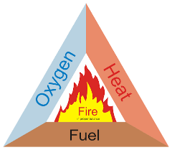
None of these can happen without the Fire Triangle: heat, fuel, and oxygen. This is fire’s food, shelter, and water
.
Primitive fire-making is the practice of creating fire without modern tools such as lighters or matches, using only natural materials and traditional techniques. Over thousands of years, different cultures have developed unique fire-making methods. These skills were passed down through generations and adapted to local environments and available resources. Today, primitive fire-making remains an important survival skill and a fascinating connection to humanity’s earliest innovations.
There are many layers to fire-making. You may be able to get an ember, but the materials that you have are what make or break turning your ember into a fire. To have a successful fire, you need to build your spark up from the bottom. The three main types of fuel for your fire are:
- Tinder. Starting with the smallest stuff that is the base of your fire, something dry that is going to catch fast, to build your coal or your spark into a flame. This can be dry grass, bark, pine needles, cattail fluff, or any material smaller around than a pencil.
- Kindling. This is your next step in the fire food chain. Kindling is a little bigger, moving into small twigs and sticks no bigger around than your thumb. These still light on fire relatively easily, but they can hold the flame for longer, feeding other parts of the fire. You want to use kindling once your tinder has caught fire.
- Fuel. The fuel is what you always think of, but it's not the easiest to ignite. It needs more heat than the tinder and kindling to catch. Softwoods like pine, spruce, and cedar ignite much more easily than other tree species, but logs of any kind can be used. These pieces are the size of your wrist or bigger.
Before you even start making the fire, you need to think about where you are making it. Choosing a safe location is very important; while fire may seem hard to start, once it gets going, it's not always the easiest to slow down. A good location is a place on a rock or in a green area. This is better because it's harder for the flame to spread because there's nothing around it that can catch on fire, and green plants are full of water that makes them more difficult to light. Always be sure to clear a “fire pit” if needed by wiping away any dead debris that could catch easily.
Moving on to the specific kinds of methods you can use to make fire.
Hand Drill Method.
Gather and prep your materials 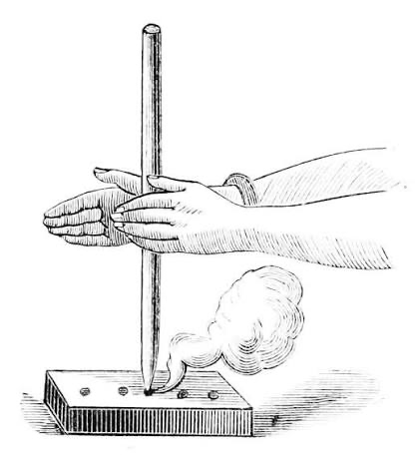
- The Spindle. You need a straight, full, dried-out stick that doesn't bend. It needs to be around 15 inches tall. The wood you use matters; the best spindle materials to use are mullein, goldenrod, and cattail stalks or cedar.
- The Fireboard. This is normally a softer, bigger piece of wood, which could be cedar, cottonwood, or aspen. When you make your fire board, you want it to be an inch thick and flat. One thing that can help is making sure you can see the growth rings. This allows for more friction when using the fire board. Next, you want to carve the fireboard using a spindle. You want to make a divot in the wood to start forming a hole for the coal. Next, carve a V-shaped notch into the divot. This notch must be wide enough at the edge to allow dust to build up and oxygen to flow but narrow enough so it doesn't swallow the spindle.
- The Tinder Bundle. This is a collection of small fibers made from shredded inner bark or dried grasses. Make sure to roll and squeeze them together to make a nest-type bundle; this will make sure the coal will catch easily.
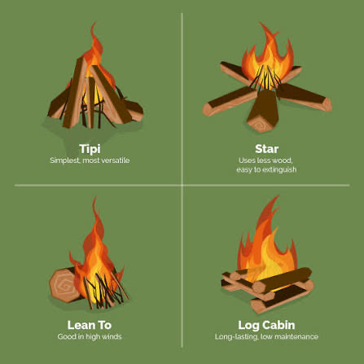
- Lastly, you want your wood to be ready and set up for the coal; this can look like many things. It must be made up of the right materials like fire fuel, tinder, and kindling. To make it light easier its best to build the fire in a lean-to, tipi, star, or log cabin.
Drilling and creating an ember
- To start, you want someone holding your fire board, or you should hold it with your foot to keep it stable. You also want to be in a stable position before you start the drill.
- Place your hands on the spindle like you were rubbing your hands together for warmth, then apply firm pressure on the spindle using your upper body weight, not just your arms.
- Rub your hand back and forth in a fast motion, slowly moving your hands down with it to keep the pressure. Once you get to the bottom, hold it with one hand while moving the other back to the top and repeat. As you're doing this, you should see the hole getting bigger and charred brown dust accumulating around the bottom of your spindle.
- Continue drilling until you see smoke and keep going for about half a minute. Then stop; you should be left with a pile of black char dust that's still smoking, which means you now have a coal.
- Nurture the flame
- Once you have your coal, leave it sitting there to let the coal breathe. You want to keep a balanced fire triangle, so with this little heat, just stagnant air is enough to feed it.
- Tap the edge of your fireboard so the ember drops into your tinder bundle. Blow softly on the bundle with the coal in it; with the right power, the bundle should light up in flames. Add it to your fire setup, and you're all set.
Next, the bow drill method is the same concept of using friction to light the fire but executed differently
Bow Drill Method
Materials and prep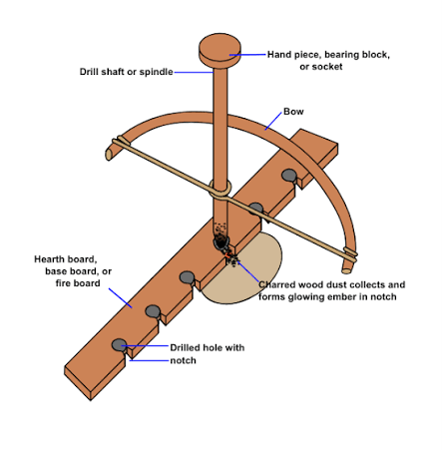
- The Spindle.
- The Bow. The bow is one strong piece of wood that has a tight string in the middle and is about the length of your arm. In this method, both the bow and the spindle are about the same width as a quarter.
- Bearing Block. This goes on top of your spindle. One side of the spindle is on the fire board; the other is held by you and the bearing block. It can be another piece of wood or a smooth, hard object. This is to keep the spindle stable and in place when doing the drill.
- The Fireboard.
- The Tinder Bundle.
- Lastly, you want your wood ready and set up for the coal when it comes, making sure to have tinder, kindling, and fuel.
Creating the ember
- Once you're all set up rap your bowstring around the spindle, making sure it is tight. Place the bottom of the spindle on the fire board and place the bearing block on the top end of the spindle. Lock your non-dominant arm securely against your shin to keep it stable.
- Move the bow back and forth in long, even strokes to drill into the board. You will notice that it is like the hand drill, just with the bow as the tool creating the spin and friction. Increase speed until you feel stable. Once a groove is established in the wood, apply firm downward pressure and faster strokes with the bow. Continue until you see a large amount of smoke coming from the bottom of the spindle and black dust coming from the V-notch, which you can see in the diagram is the small V-shaped notch coming out of the sides of the indents from the spindle.
- Stop moving the bow and let it sit there, then treat the coal how you did with the hand drill.
Flint and Steel
Materials 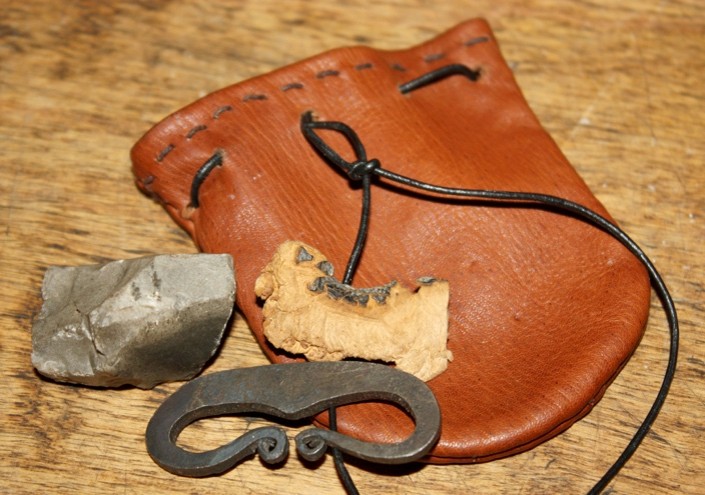
- Tinder.
- Char Cloth. Char cloth is a highly combustible material used as tinder to start fires. It is created using a process called pyrolysis—heating natural fabrics without oxygen.
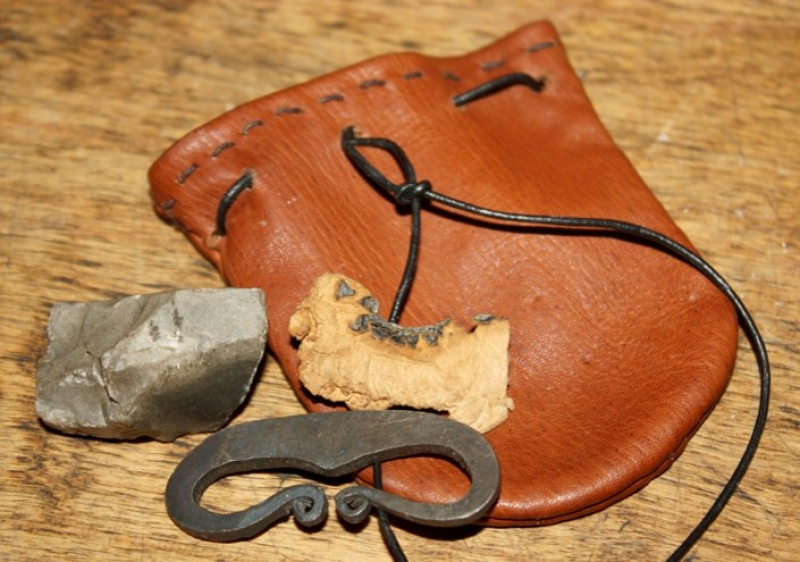
- Flint and Steel. This is the two stones you use to make the spark in the photo on the left are flint, and on the right is the steel.
Make a Spark
- Hold the flint in one hand and the steel striker in the other. Use a swift, scraping motion to break off tiny particles of steel. The friction causes these shavings to ignite in mid-air, making your spark.
- Catch the ember
- Direct the sparks to the char cloth; once it catches, slowly feed it by blowing on it slightly. Then move it to your tinder bundle and surround it so it can catch.
Primitive fire making is much more than a survival skill—it's a direct connection to our ancestors and the ingenuity that helped humanity thrive. Whether you're using a hand drill, bow drill, or flint and steel, learning these techniques teaches patience, preparation, and respect for one of nature's most powerful forces. While modern tools have made starting a fire easier than ever, understanding how to create fire from natural materials can be invaluable in a survival situation and deeply rewarding on a personal level. By practicing these ancient methods safely and responsibly, you not only gain a practical outdoor skill but also keep alive a tradition that has shaped human history for thousands of years.